Wasps’ Nests in Benahavís: What Villa Owners and Communities Should Know
A calm, practical guide to wasps, hornets, birds, bees and other nests in private villas and residential communities in Andalucía.
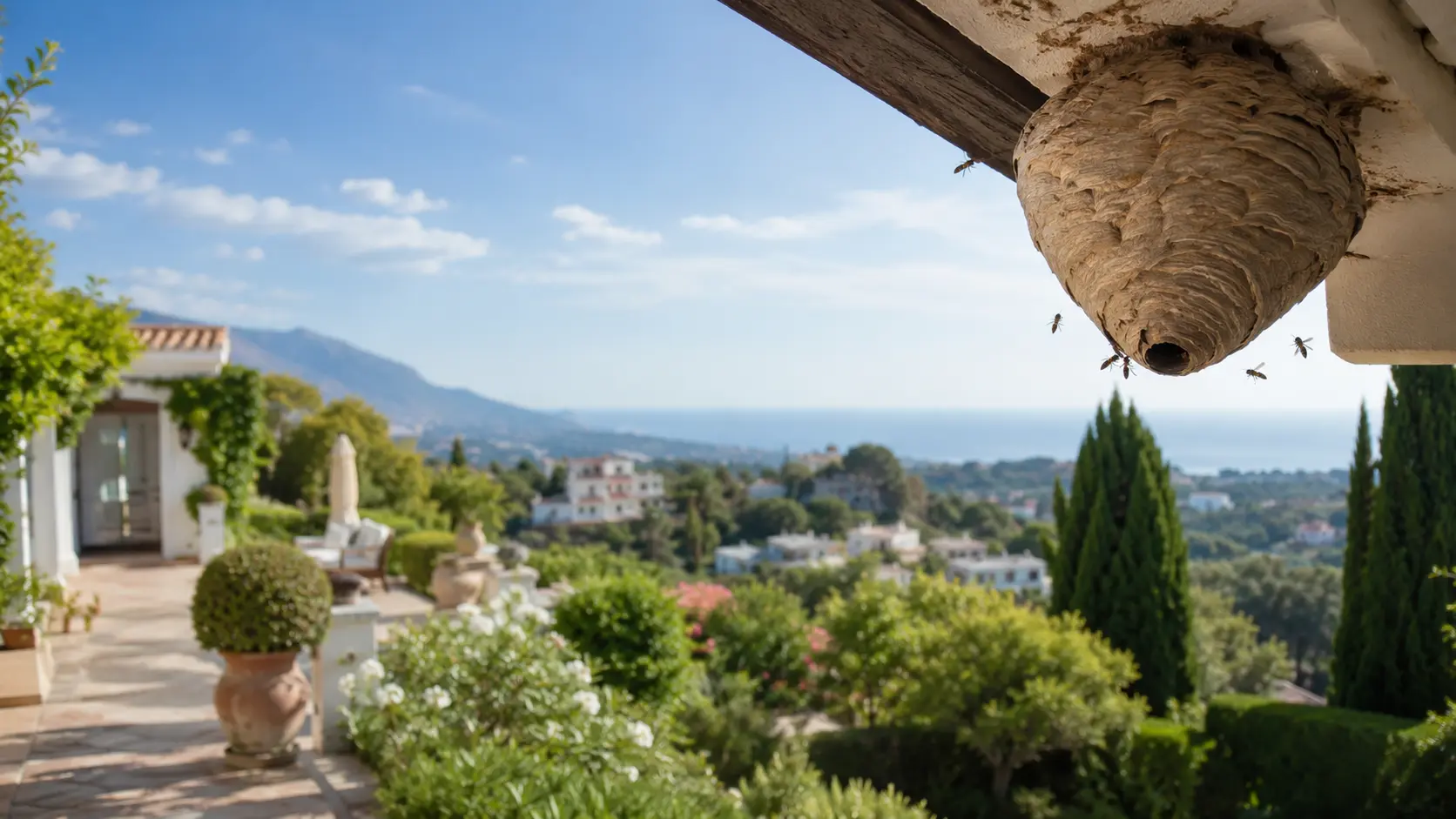
Life in Benahavís is shaped by nature. The wooded hillsides, mature gardens, golf landscapes, cork oaks, flowering borders and warm Andalusian climate are part of what makes the area so special. They also mean that villa owners, tenants, community presidents and administrators will occasionally find themselves dealing with an unexpected nest beside a terrace, under a roof tile, in a garden wall, near a pool area or above a communal walkway.
Most of the time, the first reaction is simple: remove it quickly. However, in Andalucía, the right response depends very much on what kind of nest it is. A wasps’ nest may be a health and safety issue that needs a professional pest-control visit. A bird nest may be protected by law. A bees’ nest may be better handled by a beekeeper than destroyed. Meanwhile, an unusually large hornet nest may need to be reported, particularly if Asian hornet or another invasive species is suspected.
This guide is written for private villas, holiday homes, apartment communities and urbanisations in and around Benahavís. It is not legal advice, but it should help owners and communities approach the situation calmly, safely and responsibly before anyone reaches for a spray, ladder or pressure washer.
Why Wasps Nests in Benahavís Are the Main Concern for Most Homes
In everyday residential life, wasps are usually the nest that causes the most immediate concern. They appear close to where people eat, swim, garden or relax, and their activity can increase quickly in the warmer months. A small nest under an eave in spring can become a much more active problem later in the season, particularly if it sits close to a doorway, terrace, pergola, pool shower, children’s play area or communal path.
For private villas, the issue is often straightforward: the owner or property manager notices increased wasp activity around one area of the house and calls a professional pest-control company. In a community, however, the situation can be more delicate. A nest may be in a communal garden, on a façade, near a stairwell or in a shared service area. In that case, the community president or administrator will usually need to coordinate the response, especially if access equipment, temporary closure of a pool area or notification to residents is required.
The most important point is not to disturb the nest. Spraying it casually, blocking the entrance, knocking it down, burning it or trying to hose it away can turn a manageable problem into a dangerous one. Wasps and hornets defend their nest when threatened, and multiple stings can be serious, especially for children, elderly residents, pets or anyone with an allergy.
When a Wasp Nest Should Be Treated as Urgent
A wasps’ nest becomes more urgent when it is close to people. A nest in a distant corner of a large plot may be watched and managed with care. A nest beside a front door, in a shutter box, above a terrace dining area or close to a communal pool needs a faster response. The same applies if the insects are entering the property through roof spaces, air-conditioning openings, wall cavities or utility cupboards.
In those situations, the safest approach is to keep people away, avoid vibration or noise around the nest, take a photograph from a safe distance if possible, and contact a licensed pest-control professional. If the nest creates an immediate danger to residents or visitors, emergency services should be contacted through 112.
Owners should also be particularly careful when a nest appears unusually large, high in a tree, suspended in a rounded paper-like structure, or associated with larger hornet-like insects. In recent years, invasive hornets have become a growing concern in parts of Spain and Andalucía. Benahavís Town Hall has previously advised residents who see a suspected Asian wasp nest to remain calm and contact the Ayuntamiento or report it through Línea Verde rather than attempting removal themselves.
Asian Hornets, Oriental Hornets and Why Identification Matters
Not every large wasp is an invasive hornet, and not every nest requires the same response. However, identification matters because invasive species can affect public safety, native insects and local beekeeping. The Asian hornet, often referred to in Spain as avispa asiática or Vespa velutina, has been monitored across Spain because of its impact on honeybees and other pollinators. The oriental hornet, Vespa orientalis, has also been reported in Andalucía, including Málaga province, and is watched closely because of its adaptability in urban and coastal areas.
For a homeowner or community, the practical advice is simple. Do not try to make a final identification yourself if the nest is active or difficult to access. A clear photo or short video from a safe distance can help the Ayuntamiento, a pest-control professional or the relevant authority decide what the next step should be. The priority is not bravery; it is correct reporting and safe removal.
In Benahavís, where villas often back onto natural land and communities include mature gardens, wooded areas and golf-side planting, it is entirely possible to see normal seasonal wasp activity. It is also sensible to stay alert to anything unusual, particularly if the nest is large, high, rapidly growing or attracting significant insect traffic.
What Communities Should Do Before Calling Someone Out
In residential communities, a little organisation helps. The person who finds the nest should avoid disturbing it and should notify the president, administrator or maintenance team with a clear description of the location. It is useful to note whether the nest is in a private-use area, a communal area or somewhere that affects both, such as a façade, roof void, garden boundary or garage entrance.
The administrator or president can then arrange a professional assessment and, where necessary, inform residents that a particular area should be avoided until treatment is completed. In pool areas, garden paths or entrances, temporary signs or a short community message may be enough to prevent someone walking too close before the pest-control visit takes place.
Good communities tend to handle this quietly and efficiently. There is no need to create alarm, but there is also no benefit in delay when the nest is close to daily movement. The best approach is measured: identify the risk, keep residents away, use a qualified professional and document what was done.
Private Villas: What Owners and Property Managers Should Consider
For villas, especially holiday homes or properties used by guests, wasps’ nests need prompt attention. A small issue beside a pergola or pool terrace can quickly affect the enjoyment and safety of a stay. Property managers should include nest checks as part of regular exterior inspections during spring and summer, particularly around roof eaves, shutter boxes, outdoor kitchens, pool pump rooms, garden walls, storage areas and shaded corners.
It is also worth briefing gardeners and maintenance teams. They are often the first people to notice increased wasp movement, and they may be tempted to deal with it informally. That should be avoided. A gardener cutting hedges near a hidden nest can be stung repeatedly, while an untrained removal attempt can leave part of the nest active or drive insects into the house.
For rented villas, the owner or manager should act quickly but calmly. Guests should be asked to avoid the affected area, and a professional should be called. If there is any suggestion of an invasive hornet or a significant public-safety risk, the matter should be reported rather than treated as an ordinary garden nuisance.
Bird Nests Are Different: Assume They Are Protected
Bird nests must be treated very differently from wasps’ nests. In Andalucía, wild fauna and their breeding places are protected under regional law, and Spanish national biodiversity law also protects wild animals, their nests, eggs and resting or breeding areas. This means that removing, damaging or disturbing a bird nest can be unlawful, especially during nesting season or when eggs or chicks are present.
This is particularly relevant in Benahavís and the wider Costa del Sol, where homes may host swallows, house martins, swifts, sparrows, kestrels, owls and other birds that nest around buildings, rooflines, beams, walls and terraces. Some nests may look inconvenient or untidy, but that does not mean they can simply be removed.
If a bird nest is found on a private villa or within a community, the safest assumption is that it should not be touched. If it appears active, leave it alone and avoid disturbance. If it creates a genuine safety concern, or if building work cannot proceed without affecting it, advice should be sought from the competent environmental authority, SEPRONA, the Ayuntamiento or a qualified wildlife professional. In some cases, exceptions may be possible for health or safety reasons, but they require the correct authorisation and should not be improvised by owners, contractors or community staff.
Bees, Pollinators and the Better Alternative to Destruction
Bees can also settle in villas and communities, especially in wall cavities, chimney spaces, irrigation boxes, roof voids and garden structures. Unlike wasps, bees are vital pollinators and are often best handled by a beekeeper or specialist removal service rather than destroyed. A swarm resting temporarily on a branch or wall may simply be passing through and can sometimes move on by itself within a short period.
Where bees have established themselves inside a structure, the answer is not to seal the entrance. Blocking bees inside a wall or roof can create a larger problem, including honey residue, odour, secondary insects and staining. A specialist can assess whether the colony can be removed or relocated and whether any building repair is needed afterwards.
For luxury homes and well-managed communities, this kind of response also fits the spirit of Benahavís. The landscape is part of the appeal, and careful, respectful handling of pollinators protects both the property and the environment around it.
Ants, Termites, Processionary Caterpillars and Other Nesting Problems
Not every nest is dramatic, but some still need attention. Ant nests can undermine paving, enter kitchens or appear around pool terraces. Termites and wood-boring insects can create structural concerns if they affect timber, pergolas, door frames or older beams. Processionary caterpillars, usually associated with pine trees, can be dangerous for dogs and irritating for people because of their fine hairs, particularly when the caterpillars move in their distinctive lines.
These are not the same legal issue as a protected bird nest, but they still require sensible handling. Chemical treatments should be used carefully, especially near pets, children, pools, watercourses, vegetable gardens or communal landscaping. In a community, treatment should be coordinated so residents know when gardens, lawns or paths should be avoided. In a private villa, the treatment should be matched to the species and the location, rather than applied broadly across the garden.
The best pest-control companies will not simply remove the visible problem. They will also look at why it has appeared, whether there is a water source, food source, cavity, dead wood, access point or seasonal pattern that should be managed to prevent repeat issues.
The Sensible Rule: Identify Before You Remove
The key principle for any nest in Andalucía is identification before removal. A wasps’ nest close to people may need professional pest-control treatment. A suspected Asian hornet nest should be reported. A bees’ nest may need a beekeeper. A bird nest should be assumed protected unless a competent authority confirms otherwise. Other insect nests may require specialist treatment, but still deserve a careful approach.
For owners, the most useful first step is a safe photograph and a note of the location. For communities, the first step is communication with the administrator or president. For anything involving protected wildlife, suspected invasive species or immediate public risk, the answer is not a DIY removal; it is proper advice.
Who to Contact in Benahavís
For an ordinary wasps’ nest on private property, a licensed pest-control company is usually the most practical contact. For a nest in a residential community, the community administrator or president should normally coordinate the appointment. If the nest appears to be an Asian hornet nest, Benahavís Town Hall has advised residents to contact the Ayuntamiento or notify the issue through Línea Verde.
If there is an immediate danger to people, call 112. If a bird nest or protected wildlife may be involved, contact SEPRONA, the Ayuntamiento or the Junta de Andalucía’s environmental authority before taking action. It is always better to ask first than to discover afterwards that a nest should not have been removed.
The following local contacts and specialist routes may help owners, tenants, community presidents and property managers decide who to call first.
Local Contacts and Specialists
When a nest appears in a villa, apartment community or shared garden area, the most useful response is often a calm call to the right person. The contact will depend on the type of nest, the level of risk and whether the issue is on private or communal land.
Immediate Risk or Emergency
If there is an immediate danger to people, pets, residents or visitors, call the emergency services rather than approaching the nest yourself.
Emergency: 112
Benahavís Policía Municipal: 952 855 544
Benahavís Guardia Civil: 952 855 527 / 062
Ayuntamiento de Benahavís
For suspected Asian hornet nests, public-area issues or uncertainty about the correct route, contact the Town Hall or report the issue through Línea Verde.
Ayuntamiento: 952 855 025
Email: ayuntamiento@benahavis.es
Protected Wildlife or Bird Nests
If a bird nest, protected species or wider wildlife issue may be involved, seek official guidance before disturbing or removing anything.
SEPRONA Málaga: 952 071 520
Email: ma-cmd-malaga-seprona-patrulla@guardiacivil.org
For urgent situations, use 112 or the Guardia Civil emergency number 062.
Licensed Pest-Control Specialists
For ordinary wasps’ nests, hornets, ants, termites, processionary caterpillars or other pest issues on private property, contact a licensed pest-control company and confirm that they work in Benahavís.
Fumicosol — wasp treatments in Málaga →
Hisan — wasp removal in Málaga →
Plagiser — wasp control in Málaga →
These are examples of companies offering pest-control services in Málaga province. Owners and communities should always check current availability, qualifications, insurance, pricing and suitability before appointing any contractor.
Bee Swarms and Pollinators
If the issue appears to be bees rather than wasps, avoid fumigation where possible. A beekeeper or specialist swarm collector may be able to advise or relocate the swarm.
Spanish beekeeper swarm collection network →
If the swarm creates an immediate risk in a public or residential area, call 112 for guidance.
For Communities and Administrators
In apartment communities and urbanisations, the president or administrator should normally coordinate the response, especially when the nest affects a communal garden, pool area, stairwell, garage, façade or shared service space.
Keep residents away from the area, document the location with a safe-distance photo, and use a qualified professional rather than allowing gardeners, cleaners or maintenance staff to attempt removal informally.
Useful Official Sources
For homeowners, community presidents and property managers who want to check the official guidance directly, the following sources are useful starting points:
Junta de Andalucía — Ley 8/2003 de la Flora y la Fauna Silvestres
Junta de Andalucía — Exceptions to generally prohibited activities involving wild flora and fauna
BOE — Ley 42/2007 del Patrimonio Natural y de la Biodiversidad
MITECO — Strategy for the control, management and possible eradication of Vespa velutina in Spain
Ayuntamiento de Benahavís — Avispa Asiática notice
A More Considered Way to Live with Nature
Benahavís offers a rare balance: hillside privacy, mature gardens, golf views, quiet communities and close contact with the natural world. That beauty comes with small responsibilities. A nest near a terrace or communal path may be inconvenient, but it is also part of a wider living landscape of birds, pollinators and seasonal wildlife.
The goal is not to leave dangerous nests unmanaged. It is to respond in the right way. Protect people, protect pets, respect wildlife law, use professionals, and report anything unusual. For villa owners, community presidents and property managers, that calm and informed approach is the safest route — and the one most in keeping with life in Benahavís.
Related Reading
For owners, community presidents and property managers, nests are only one part of protecting a home in Benahavís. These related guides look at other practical household risks, from water ingress and insurance to emergency contacts and community responsibilities.
Wildfire & Home Insurance
Understand why fire cover matters on the Costa del Sol, especially for villas, hillside homes and properties close to natural land.
Water Damage in Spanish Communities
A clear guide to who is responsible when leaks, damp patches or storm-related water damage appear in community properties.
Community Insurance Policies
Learn what community insurance usually covers in Spanish apartment buildings and urbanisations, including shared areas and common risks.
Amenities & Services in Benahavís
A practical local guide to emergency numbers, utilities, police, healthcare, security and everyday services for residents.
Important note: This article is general guidance for homeowners and communities in Andalucía. It is not legal advice. Rules and procedures can change, and protected wildlife cases should always be checked with the competent authority before any nest is disturbed or removed.