Residency & NIE Essentials in Spain
A practical guide for international buyers, second-home owners and future residents in Benahavís, covering the NIE number, Spanish bank accounts, residency routes, health insurance and the first administrative steps most buyers encounter.
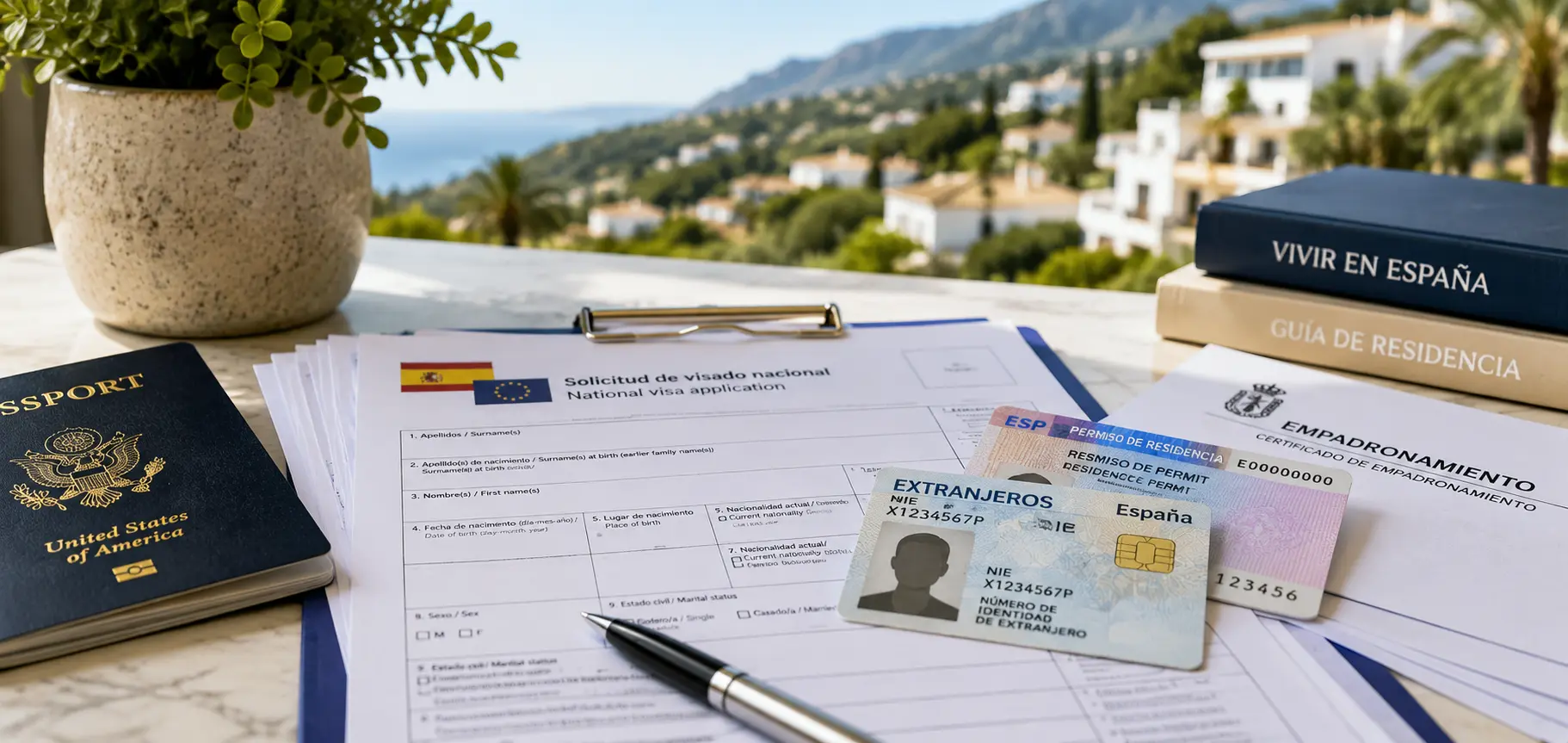
Updated May 2026: This guide is intended as a practical starting point for buyers and future residents. NIE, residency, visa and bank requirements can change, and individual circumstances vary. Always confirm the latest requirements with your lawyer, gestor, bank, consulate or immigration adviser before submitting documents.
If you are buying a property in Benahavís, spending extended time in Spain or planning a future move, there are several administrative steps that appear early in the process. The most important is usually obtaining an NIE, the Número de Identificación de Extranjero.
The NIE is not a visa and it is not, by itself, a residence permit. It is your foreigner identification number for Spanish administrative, legal and tax matters. For property buyers, it becomes essential very quickly because it is normally needed for the purchase deed, tax payments, bank accounts, utilities and many formal contracts.
For most Benahavís buyers, the process is manageable when organised early. In practice, your lawyer often coordinates the NIE, bank-account setup and related documentation as part of the pre-completion process. This helps avoid delays later, especially when completion dates, mortgage timing, money transfers and tax payments need to align.
Need Help Coordinating These Steps?
Darren & Angelina — your Personal Property Concierge — can introduce trusted lawyers, help you understand which steps usually come first, and support you in preparing for a smooth Benahavís property purchase.
We do not hold client funds and we do not replace independent legal advice. Instead, we help you stay organised, ask the right questions and connect with the right professionals at the right time.
What Is an NIE?
The NIE is Spain’s foreigner identification number. It is assigned to foreign nationals who have economic, professional or social interests in Spain, including people buying property, opening bank accounts, signing contracts, paying taxes or applying for residency.
Once issued, the NIE number itself is permanent. It does not change each time you buy, sell, move address or later become resident. However, the document or certificate showing the number may be requested in updated form by banks, lawyers or authorities depending on the procedure.
The number usually follows a format with an initial letter, seven digits and a final check letter, for example X1234567T. For property buyers, it will appear on legal documents, tax forms, purchase deeds and many administrative records connected to the transaction.
For Property Purchases
You normally need an NIE before signing the public purchase deed, paying purchase taxes and completing the legal transfer of the property.
For Banking & Utilities
Banks, utility providers and tax systems often require an NIE to set up accounts, direct debits and owner records correctly.
For Residency
The NIE is used throughout the residency process, but it is not the same as a residence permit or TIE card.
NIE, TIE and Residency: What Is the Difference?
These terms are often confused, especially by international buyers starting their Spanish property journey. The simplest way to separate them is to think of the NIE as your identification number, residency as your legal status, and the TIE as a physical card issued to certain non-EU nationals who have a residence authorisation.
An NIE may be needed even if you do not live in Spain. For example, a non-resident buyer purchasing a holiday home in Benahavís will normally need an NIE, even if they only visit Spain for short stays. Residency, by contrast, is a separate legal position connected to your right to live in Spain for longer periods.
The TIE, or Tarjeta de Identidad de Extranjero, is different again. It is the physical foreigner identity card used by certain non-EU residents once their residence status has been approved. Your lawyer or immigration adviser can confirm whether your circumstances require only an NIE, a visa, a residency application, a TIE appointment or a combination of these steps.
Practical note: Buying a property in Spain does not automatically grant residency. Property ownership and residency are separate matters, although property ownership may form part of your wider life plan, financial profile or visa preparation.
How Buyers Usually Apply for an NIE
There are several routes to obtain an NIE. Applications may be made in Spain, through a Spanish Consular Office in the applicant’s country of residence, or through a properly authorised representative in Spain. For property buyers, the most common practical route is often through a lawyer using a Power of Attorney.
This is especially useful if you are not in Spain full-time. A Power of Attorney can allow your lawyer to handle key pre-completion tasks, including NIE application, bank coordination, tax matters and certain purchase formalities, depending on the authority granted.
The documents usually include the completed EX-15 application form, passport, passport copy, a reason for needing the NIE and the official fee form. The precise requirements can vary depending on where the application is made, so it is sensible to confirm the checklist before the appointment or submission.
Applying in Spain
This is usually handled through the police / foreigner administration appointment system. Availability varies by province and timing.
Applying via Consulate
Spanish consulates can process NIE applications abroad, although timings, appointments and document rules vary by consular office.
Applying via Lawyer
Many Benahavís buyers authorise their lawyer to obtain the NIE as part of the purchase preparation, often using a Power of Attorney.
Typical NIE Preparation Checklist
- Completed EX-15 application form.
- Valid passport and passport copy.
- Reason for requesting the NIE, such as a property purchase.
- Official fee form and payment confirmation where required.
- Power of Attorney if your lawyer is applying on your behalf.
Timescales vary. In some cases, the NIE can be obtained quickly; in others, appointments, consulate processing times or documentation issues can add delays. For a property purchase, it is best to start early rather than wait until the final stages of the transaction.
Opening a Spanish Bank Account
A Spanish bank account is strongly recommended before completion. It allows purchase funds, local taxes, utilities, community fees, insurance and ongoing property costs to be handled more smoothly. Some buyers also use a Spanish account for mortgage payments, rental income or property-management expenses.
Banks apply compliance checks, particularly for non-residents. They may ask about source of funds, employment or business activity, tax residence, proof of address and the purpose of the account. This can feel slow, but it is a standard part of anti-money-laundering and banking compliance.
For buyers transferring funds from abroad, currency strategy also matters. Exchange rates, transfer timing and bank charges can affect the final euro amount available for completion. Some clients use specialist currency providers, while others prefer to work directly through their bank. Your lawyer should confirm the safest payment route for reservation, deposit and completion funds.
Important: Benahavís Collection does not hold reservation fees, deposits or client funds. Buyers should normally pay reservation or purchase funds through their lawyer’s client account or another properly advised legal route, never casually to an agent or third party without legal confirmation.
Documents Banks May Request
Passport, NIE, proof of address, tax information, employment or pension evidence, business documents, source-of-funds evidence and property-purchase details.
Why Set Up Early?
Bank onboarding can take longer than expected. Starting early avoids delays with utilities, taxes, completion payments and post-purchase direct debits.
Non-Resident Accounts
Non-resident buyers can usually open a Spanish account, although the bank may require periodic compliance updates or non-resident status checks.
Residency Routes: When NIE Is Not Enough
If you plan to live in Spain rather than simply buy a property or visit for limited periods, you may need to consider a visa or residency route. The right option depends on your nationality, work situation, income, pension, family circumstances and intended time in Spain.
For EU citizens, residency administration is different from the process for non-EU nationals. For UK, US and other non-EU citizens, options may include routes such as the Non-Lucrative Visa, Digital Nomad Visa, work-related authorisations or family-based routes, depending on eligibility.
The important point is that the NIE alone does not give you the right to live in Spain indefinitely. It is an identification number used for transactions and administration. Residency status must be considered separately if your plans go beyond normal visitor limits.
Practical note: If your property purchase is part of a relocation plan, speak to a visa or immigration specialist before relying on assumptions. Timing matters, especially where school enrolment, healthcare, tax residence, remote work or family moves are involved.
→ Read our Spain visa options guide
Health Insurance for Residency Applications
Private health insurance is a common requirement for several Spanish residency routes, especially for applicants who are not entering the Spanish public healthcare system through employment or social security contributions.
For routes such as the Non-Lucrative Visa, the policy normally needs to provide full healthcare coverage in Spain, be valid for the required period and cover the risks insured by Spain’s public health system. Consulates and immigration advisers often expect policies to be issued by insurers authorised to operate in Spain and to avoid gaps, exclusions or co-payment structures that could cause problems.
The cost depends on age, medical history, provider, cover level and family composition. A younger applicant may pay relatively modest monthly premiums, while older applicants or families may need a more careful comparison of policies.
Check the Visa Route
Insurance rules vary by residency type. Do not assume that a travel policy or basic private policy will satisfy the requirement.
Check the Policy Terms
Look carefully at co-payments, waiting periods, exclusions, hospital cover and whether the insurer is accepted for Spanish residency applications.
Check the Dates
Insurance dates should align with the visa or residency application requirements. A mismatch can cause avoidable delays.
How This Fits Into a Benahavís Property Purchase
For most international buyers, the NIE, bank account and legal representation are part of the same practical sequence. The earlier these are organised, the easier the purchase process becomes.
A typical buyer may first reserve a property through their lawyer, grant Power of Attorney, apply for an NIE, prepare bank compliance documents, transfer funds, complete due diligence and then sign the purchase deed at notary. The exact order varies, but the underlying principle is the same: avoid leaving administrative steps until the last moment.
This is especially important in Benahavís, where purchases can range from apartments and townhouses to large villas, gated estates, new developments and rural-style homes. More complex properties often require more document review, so the buyer’s legal and financial preparation should be equally organised.
Buyer tip: Ask your lawyer early which documents they need from you, which tasks they can handle under Power of Attorney, and whether your bank account, NIE and funds will be ready before the target completion date.
Common Mistakes to Avoid
The most common problems are not usually legal surprises. They are timing and coordination issues. Buyers may find a property first, then discover that bank compliance, NIE applications, money transfers or consular appointments take longer than expected.
Another mistake is assuming that property ownership and residency are the same thing. You can own property in Spain without being resident, and you can become resident without buying property. The two may support the same life plan, but they are legally separate.
Finally, buyers should avoid relying on informal advice for immigration, tax residence or healthcare decisions. These areas depend heavily on nationality, time spent in Spain, income, family circumstances and future plans. Professional guidance at the beginning is usually cheaper than trying to fix a mistake later.
Leaving the NIE Too Late
Start early, especially if you are applying from abroad or relying on appointment availability.
Opening a Bank Account Too Late
Bank compliance can take time, particularly for international buyers with overseas income, business interests or complex source-of-funds documentation.
Confusing NIE with Residency
The NIE is an identification number. It does not replace a visa, residence permit or TIE card where those are required.
Buying or Relocating to Benahavís?
Darren & Angelina — your Personal Property Concierge — can help you understand the practical sequence: finding the right area, appointing a lawyer, preparing NIE and bank-account steps, and coordinating the purchase around your wider lifestyle or relocation plans.
We work alongside independent lawyers, tax advisers, banks and professional partners so that your property search is supported by the right local guidance.
Helpful Related Guides
Spain Visa Options
Compare the main visa and residency routes for non-EU buyers, remote workers, retirees and families considering life in Spain.
Purchase Costs in Andalucía
Understand the main buying costs, including transfer tax or IVA, notary, registry and legal fees.
Property Finder
Ask Darren and Angelina for tailored help comparing properties, areas and practical ownership considerations in Benahavís.
Looking for a home outside Benahavís?
Holiday Homes Spain
covers the whole Costa del Sol.