Retiring in Florida vs Costa del Sol
A 2026 retirement cost comparison covering monthly living costs, healthcare, property, insurance, residency and lifestyle.
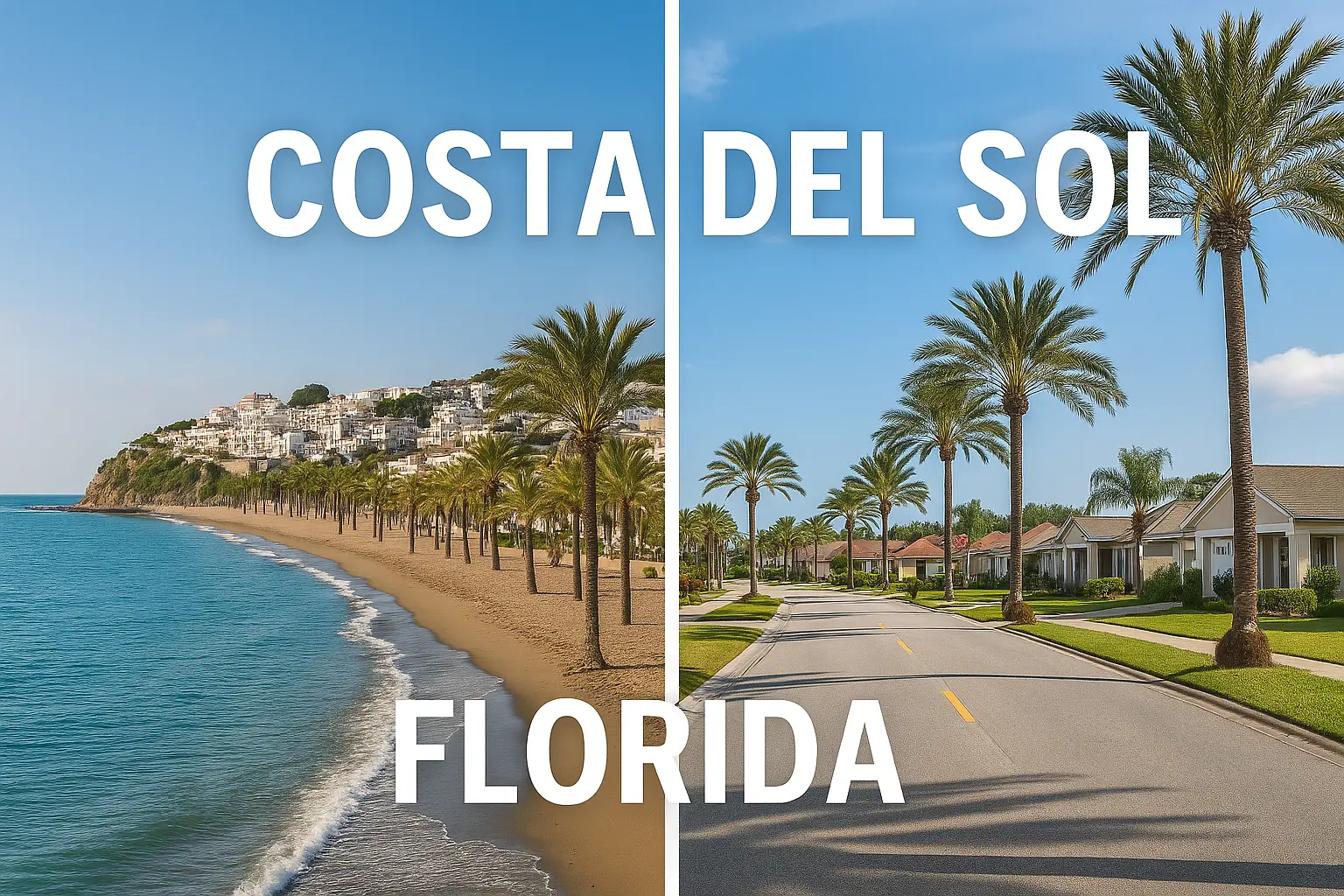
Two classic sunshine retirement destinations — but very different when it comes to healthcare, insurance, running costs and how far your retirement budget really goes.
This 2026 guide compares retiring in Florida vs Costa del Sol, using realistic monthly cost ranges, property examples and rounded currency equivalents to show the difference in practical terms.
For decades, Florida has been the default retirement dream for many Americans: palm-lined streets, golf communities, warm winters and familiar services. Meanwhile, the Costa del Sol has quietly evolved into its European counterpart, offering sea views, relaxed Mediterranean living and a deeply international community around Marbella, Benahavís, Estepona and the wider Málaga coast.
On the surface, the two lifestyles can appear similar. Both offer sunshine, golf, coastlines and established international communities. However, once you look more closely at property prices, healthcare, home insurance, residency and day-to-day costs, the differences become striking.
This article compares Benahavís and the wider Costa del Sol with Florida retirement markets such as The Villages, Sarasota and Naples. For ease of comparison, the article uses rounded currency guide rates of €1 = $1.16 and $1 = €0.86. Exact results will vary depending on the exchange rate available when funds are transferred. You can check recent averages at X-Rates.
At a Glance: Retirement Costs in 2026
For many retirees, the Costa del Sol offers the strongest advantage in everyday running costs. Food, local services, private healthcare and home ownership costs are often more predictable than in Florida, while the lifestyle remains centred around sunshine, outdoor living and established international communities.
| Location | Comfortable monthly spend for a couple | Approx. currency equivalent | Main cost pressure |
|---|---|---|---|
| Costa del Sol | €1,700–2,500 | ≈ $1,970–2,900 | Housing choice and private healthcare level |
| Florida retirement areas | $3,200–4,700 | ≈ €2,750–4,040 | Healthcare, insurance, car costs and HOA/property ownership costs |
These are broad 2026 guide figures for two adults and exclude rent or mortgage payments. Florida ownership costs can rise further when property tax, homeowners insurance, flood insurance and HOA fees are added.
Retiring in Florida vs Costa del Sol: Monthly Living Costs
The key question most retirees ask is simple: how much do we actually need each month to live comfortably?
On the Costa del Sol, a retired couple living comfortably but not extravagantly might spend around €1,700–2,500 per month before rent or mortgage. That would normally cover food, moderate dining out, utilities, telecoms, car running costs, private healthcare and regular lifestyle spending. In US dollar terms, that is roughly $1,970–2,900 per month.
In Florida retirement areas, a similar couple can easily spend around $3,200–4,700 per month before rent or mortgage, especially once healthcare premiums, supplements, car costs and higher household insurance pressures are included. In euro terms, that is approximately €2,750–4,040 per month.
Numbeo’s Malaga–Miami comparison also points in the same direction, with Miami significantly more expensive than Malaga across cost-of-living categories excluding rent, and even more expensive once rent is included. See the Malaga vs Miami comparison.
Key takeaway: for a similar retirement lifestyle, many couples find the Costa del Sol can be around 30–50% lower than Florida before housing, and the difference can widen further when healthcare, property insurance and community fees are included.
Costa del Sol Retirement Costs in 2026
For retirees in Benahavís, Marbella, Estepona and the wider Costa del Sol, the largest advantage is not usually one single bill. It is the combined effect of lower everyday costs, more affordable private healthcare options and a lifestyle where many pleasures — walking, coastal cafés, village lunches, golf, beaches and time outside — are part of daily life.
A realistic monthly budget for a couple might look like this:
- Food and dining: €650–850 per month, or approximately $750–985
- Utilities and telecoms: €220–300 per month, or approximately $255–350
- Car costs: €250–400 per month, or approximately $290–465
- Private healthcare: €250–450 per month for many couples, or approximately $290–520, depending heavily on age, cover and medical history
- Extras and lifestyle: €330–500 per month, or approximately $380–580
This creates a broad retirement-planning range of around €1,700–2,500 per month, or approximately $1,970–2,900, before rent or mortgage. Some couples will spend less, especially if they own outright and use local services carefully. Others will spend more if they choose frequent restaurants, premium healthcare cover, regular travel or a high-service gated community.

Florida Retirement Costs in 2026
Florida offers familiarity, warm winters and a huge retirement infrastructure, but the cost picture has changed. Many retirees now need to think carefully about healthcare premiums, insurance, car dependence, HOA fees and the rising cost of maintaining a home in a hurricane-exposed state.
A realistic monthly budget for a retired couple in established Florida retirement areas might look like this:
- Food and dining: $1,100–1,500 per month, or approximately €945–1,290
- Utilities and telecoms: $450–650 per month, or approximately €390–560
- Car costs: $650–900 per month, or approximately €560–775, especially for households running two cars
- Healthcare premiums and out-of-pocket planning: $750–1,150 per month, or approximately €645–990, depending on Medicare choices, supplements, prescription cover, dental, vision and income-related surcharges
- Extras, co-pays and lifestyle: $250–500 per month, or approximately €215–430
This gives a broad planning range of around $3,200–4,700 per month, or approximately €2,750–4,040, before rent or mortgage. The figure can rise if the household has high prescription costs, private dental bills, long-distance driving, club memberships or substantial HOA fees.
There are also major ownership costs to consider. CMS lists the standard 2026 Medicare Part B premium at $202.90 per person per month, before supplements, Part D, dental, vision or income-related surcharges. Florida homeowners insurance is also a major pressure point: Bankrate’s 2026 Florida figure is around $5,838 per year for a $300,000 dwelling policy, before flood insurance or location-specific increases. You can check the Medicare details through CMS and Florida insurance figures through Bankrate.
Property Prices: Costa del Sol vs Florida
Property pricing is more nuanced than the monthly cost comparison. Florida can look more affordable at entry level, especially in large inland retirement communities. However, the long-term cost of ownership can change the equation once property tax, homeowners insurance, flood risk, HOA fees and maintenance are included.
In Benahavís and the wider Costa del Sol, typical retirement-friendly property budgets vary widely. Apartments, townhouses and semi-detached homes can sit from the mid-hundreds of thousands, while villas in prime golf, hillside and gated communities move into the seven-figure range. A practical mid-market range for many lifestyle buyers might be around €450,000–2,000,000, or approximately $520,000–2,320,000.
In Florida retirement markets such as The Villages, Sarasota and Naples, the range is also broad. A typical mid-market range might be around $360,000–1,500,000, or approximately €310,000–1,290,000, depending heavily on location, age, size, community fees and proximity to the coast.
At entry level, Florida may appear cheaper. However, a Costa del Sol home can look more attractive over the longer term if annual ownership costs are lower and healthcare remains more predictable. For buyers comparing Florida and Spain, the real question is not simply purchase price. It is the total annual cost of living, owning and staying healthy.
Like-for-like example: a €700,000 Costa del Sol townhouse equates to roughly $812,000. A $700,000 Florida home equates to roughly €602,000. The headline prices may look comparable, but the annual costs attached to each property can be very different.
Healthcare: Spain vs Florida
Healthcare is one of the biggest differences between retiring in Florida vs Costa del Sol. Spain combines a strong public healthcare system with private healthcare options that are generally more affordable and more predictable than many US retirees are used to.
In Spain, retirees may access public healthcare depending on residency status, social security position, reciprocal rights or private arrangements. Many international retirees also hold private medical insurance, particularly when applying for visas or when they want faster access to English-speaking specialists and private hospitals. For many couples, private cover might sit around €250–450 per month, or approximately $290–520, though age and health history matter.
In Florida, Medicare helps many retirees, but it does not mean healthcare is free. For 2026, the standard Medicare Part B premium alone is $202.90 per person per month. A couple therefore starts at around $405.80 per month, before Medigap or Medicare Advantage choices, Part D prescription cover, dental, vision, deductibles, co-pays and income-related surcharges.
In practical terms, Spain often offers the greater sense of predictability. Florida may still suit retirees who are already embedded in the US system, but those comparing both destinations should look carefully at the full healthcare picture over five, ten or twenty years.
For Spain-specific planning, read our guide to health insurance for the Non-Lucrative Visa.
Residency and Visas: Spain vs the US
Spain offers clear residency routes for international retirees, especially through the Non-Lucrative Visa. This is often the main route for non-EU retirees who want to live in Spain without working, provided they can show sufficient income or savings and suitable healthcare cover.
Spain also offers other routes for different profiles, including the Digital Nomad Visa for eligible remote workers. However, the property-linked Golden Visa route has now closed, so buying a home no longer creates a residency route by itself.
The United States does not offer a dedicated retirement visa in the same way. That makes long-term retirement in Florida more straightforward for Americans, but more complex for non-Americans who simply want to relocate there for lifestyle reasons.
You can read more in our guide to visas for retirement in Spain.
Lifestyle: Florida vs Mediterranean Living
Florida offers convenience, structured communities and familiarity. For many Americans, that is part of its appeal. The lifestyle can feel easy to understand, particularly in retirement areas built around golf, shopping, medical services and community clubs.
The Costa del Sol offers something different. In Benahavís and the wider Marbella area, retirement is less about a closed retirement environment and more about living within a Mediterranean region that blends village life, coast, mountains, restaurants, golf, healthcare and international culture.
Daily life often feels more varied. A week might include a walk through Benahavís village, lunch on a shaded terrace, a morning by the sea, a medical appointment in Marbella, a round of golf, and a quiet evening at home overlooking the hills. For many retirees, that balance is the real advantage.
The decision is therefore not only financial. Florida offers familiarity and scale. The Costa del Sol offers a lower-cost, more European rhythm, with sunshine, outdoor living and easier access to the rest of Europe.
How Much Do You Need to Retire on the Costa del Sol?
A couple can often live comfortably on the Costa del Sol from around €1,700–2,500 per month, excluding rent or mortgage. In US dollar terms, that is approximately $1,970–2,900. A more modest couple may spend closer to the lower end, while a high-comfort lifestyle with frequent restaurants, private healthcare upgrades, travel and premium community fees may sit higher.
For a simple planning framework, think of three bands. A lean but comfortable lifestyle may begin around €1,500 per month, or around $1,740, if housing is already covered and spending is controlled. A comfortable lifestyle often sits around €1,800–2,400, or approximately $2,090–2,785. A higher-comfort retirement may begin around €2,500+, or around $2,900+, excluding housing.
Even at higher spending levels, many retirees remain below equivalent Florida costs, particularly when they compare healthcare, insurance, home ownership and daily services on a like-for-like basis.
Thinking About Retiring to Spain?
Get our complete guide to buying property on the Costa del Sol, with sections on visas, healthcare, costs, education, retirement and where to buy.
Final Summary: Why the Costa del Sol Often Wins
Florida remains one of the world’s best-known retirement destinations. It offers sunshine, convenience, familiar systems and a vast retirement infrastructure. For many Americans, that familiarity matters.
However, the Costa del Sol offers a compelling alternative for retirees who are open to living internationally. Monthly costs are often lower, healthcare can be more predictable, property ownership may carry fewer insurance pressures, and Spain provides clearer residency pathways for many non-EU retirees.
When you combine lower everyday costs, Mediterranean outdoor living, access to healthcare, good flight connections and a calmer pace of life, the Costa del Sol becomes more than a cheaper alternative. For many retirees, it offers a more rewarding way to live.
For many retirees, the Costa del Sol is not just cheaper than Florida — it can feel richer, calmer and easier to enjoy.
FAQs
Is it cheaper to retire in Spain or Florida?
In many cases, retiring in Spain is cheaper than retiring in Florida. Couples often find that monthly costs on the Costa del Sol are around 30–50% lower, especially when healthcare, insurance and everyday living expenses are compared carefully.
How much money do you need to retire on the Costa del Sol?
As a guide, a couple can often live comfortably from around €1,700–2,500 per month excluding rent or mortgage. A more modest lifestyle may begin around €1,500 per month if housing is already covered, while higher-comfort lifestyles can sit above €2,500 per month.
Can Americans retire in Spain full-time?
Yes. Americans can apply for Spain’s Non-Lucrative Visa, which allows residency without working, provided income, savings and healthcare requirements are met. The right route should always be checked with an immigration professional before planning a move.
Is healthcare cheaper in Spain or Florida?
For many retirees, healthcare in Spain is cheaper and more predictable. Florida retirees may rely on Medicare, but premiums, supplements, prescription cover, co-pays and dental or vision costs can still add up significantly.
Where is the best place to retire on the Costa del Sol?
Benahavís, Marbella and Estepona are all popular with international retirees because they combine climate, healthcare access, restaurants, golf, infrastructure and established international communities. The best choice depends on whether you prefer village life, beach access, golf communities or hillside privacy.
Related Reading
Cost of Living Costa del Sol
Compare the Costa del Sol with London, New York and Toronto, including monthly costs, property values and currency examples.
Visas for Retirement in Spain
A practical guide to the main visa routes for retirees, including income, healthcare and planning considerations.
Health Insurance for the Non-Lucrative Visa
Understand the type of private medical insurance usually required when applying for Spain’s Non-Lucrative Visa.
Have a Question About Benahavís?
Darren & Angelina — your Personal Property Concierge — can help with property, relocation, lifestyle and area questions across Benahavís. Send us a short message and we’ll point you in the right direction.
Looking for a home outside Benahavís?
Holiday Homes Spain
covers the whole Costa del Sol.