Living on the Costa del Sol
10 Unwritten Rules of Life on the Costa del Sol
From late dinners and long lunches to understanding that Benahavís is much more than its village, some things about life on the Costa del Sol only begin to make sense once you spend time here.

Nobody hands you a rulebook when you arrive on the Costa del Sol. Yet spend enough time here and you begin to notice that everyday life has its own rhythm.
Lunch starts later than you expected. An apparently sleepy afternoon can turn into a wonderfully busy evening. A quick coffee can last an hour. And when someone says they live in Benahavís, their home might be in a white mountain village, beside a golf course or only a few minutes' drive from San Pedro de Alcántara.
None of the following are really rules. The Costa del Sol is far too international for that. Think of them instead as the little things you gradually pick up — the habits, timings and local peculiarities that make the area easier to understand once you stop experiencing it purely as a holiday destination.
1. Don't confuse Benahavís village with Benahavís
This is probably the first unwritten rule worth learning, because it catches out visitors and property buyers alike.
Benahavís village is the beautiful white pueblo tucked into the hills behind the coast. Benahavís municipality, however, is enormous by comparison. It covers around 145 square kilometres, stretching through mountains, river valleys, golf courses and residential communities towards Marbella, Estepona and the coast.
That means someone living in La Quinta, Los Arqueros, La Alquería or La Zagaleta can have a Benahavís address while conducting much of their everyday life around San Pedro, Nueva Andalucía, Marbella or Estepona. It is one of the peculiarities that makes the area so interesting: Benahavís can feel simultaneously like an Andalusian mountain village and part of the wider Marbella lifestyle.
The Benahavís difference
When looking at a home here, the name of the municipality tells you surprisingly little about how you will actually live. The individual neighbourhood, access road and direction you naturally travel in often matter much more.
2. Dinner at 7pm is possible. It just isn't particularly late.
One of the easiest ways to identify a new arrival from northern Europe is the time they start thinking about dinner.
Across Andalucía, lunch commonly begins from around 1pm onwards and dinner often does not properly get going until after 8:30pm. On the Costa del Sol, where restaurants serve a highly international population, you can of course eat earlier. Nobody is going to confiscate your menu because you sit down at 7pm.
But wait another hour or two and the atmosphere often changes completely.
In Benahavís village, particularly on a warm summer evening, terraces that seemed quiet earlier begin to fill. Families arrive. Tables are pushed together. Children are still awake. People wander between restaurants and bars, and what felt like the end of the day suddenly feels much more like its second half.
3. The weather doesn't just affect your day — it helps organise it
The Costa del Sol's climate is one of the principal reasons people choose to live here. Summers are typically hot and dry, winters are comparatively mild and sunshine is something residents can usually take for granted rather more often than in northern Europe.
But living somewhere sunny is slightly different from spending a week beside a swimming pool.
In July and August, experienced residents tend to work with the heat rather than challenge it. Walking the dog, hiking, cycling, gardening or tackling outdoor jobs feels very different at 8am from 3pm. Shaded terraces matter. So do shutters, awnings and the orientation of a home. Cars mysteriously migrate towards whichever side of the street happens to have shade.
Then, towards evening, everything opens up again. The temperature softens, terraces come alive and activities that might seem unusually late elsewhere feel completely natural. It isn't necessarily about having a siesta. It is simply about learning that the most comfortable version of a Mediterranean day has a rhythm of its own.
4. Lunch can quietly become the afternoon
You may begin with every intention of having a quick lunch.
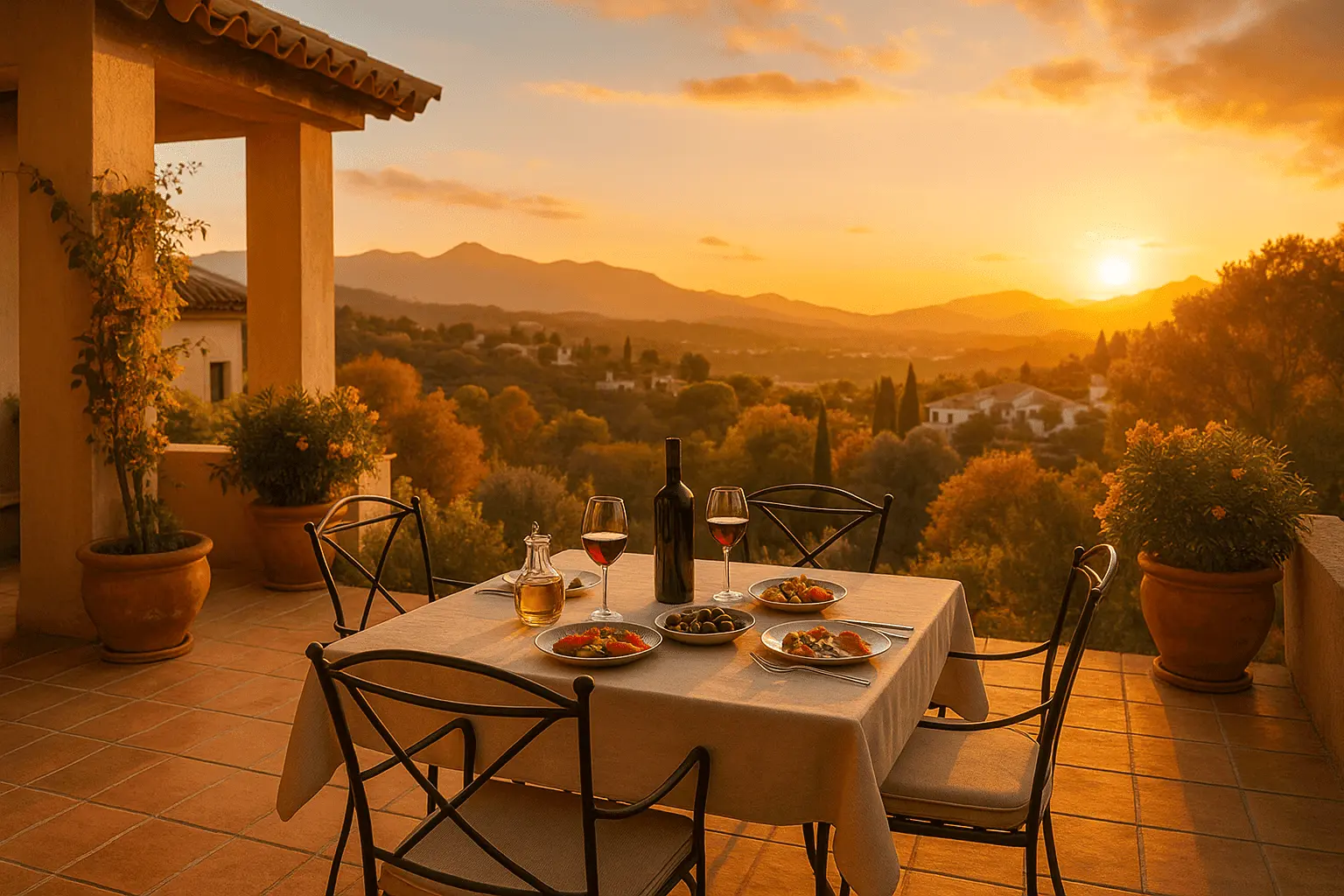
Then somebody orders coffee. The conversation carries on. Another bottle of water arrives, perhaps followed by another glass of wine. Nobody is looking at the clock and the restaurant staff seem in no particular hurry to make you leave.
This is the territory of sobremesa — the time spent talking at the table after the meal itself has finished. You don't need to know the word to recognise the experience.
It feels especially natural in a place such as Benahavís, where eating out is woven into social life. Lunch is not always something squeezed between two appointments. Sometimes lunch is the appointment.
5. Costa del Sol food is about far more than paella and sangria
Arrive with the standard holiday image of southern Spain and it is easy to imagine seafood, paella, tapas and a jug of sangria beside the beach.
All of those things have their place. But move a few kilometres inland and the picture changes.
Benahavís is a mountain town, and its traditional cooking reflects that. Local menus have long included lamb, venison, suckling pig, rabbit and other meats alongside fish and seafood, Mediterranean ingredients and an increasingly international restaurant scene.
That combination is part of what makes eating here interesting. The coast and the mountains are remarkably close together, so culinary traditions overlap rather than fitting neatly into a single postcard version of Spanish food.
And if you really want to understand the local restaurant culture, don't feel obliged to seek out a particular famous Spanish dish. Look at what other tables are eating, ask what is good that day and leave some room for discovering something you had not planned to order.
Explore our guide to dining and restaurants in Benahavís →

6. A quiet afternoon doesn't mean nothing is happening
There are moments on the Costa del Sol when somewhere can appear strangely quiet. It is hot, several smaller shops are closed and a village street that was busy in the morning suddenly feels almost empty.
Come back later.
Smaller independent businesses may still close for part of the afternoon, while supermarkets, shopping centres and many businesses in the larger coastal towns operate continuously. There is considerable variation, particularly in areas serving visitors and international residents, but the traditional split-day rhythm has certainly not disappeared.
The useful lesson isn't that Spain closes for a mythical daily siesta. It is simply not to assume that the continuous opening hours familiar elsewhere apply to every independent shop or business here. Check first — particularly if you are planning an important errand in the middle of the afternoon.
7. Twenty kilometres isn't always twenty minutes — and the closest place isn't always the quickest
Distances on a map can be particularly deceptive on the western Costa del Sol.
The coastline, mountains, main roads and residential communities do not sit neatly alongside one another, so the number of kilometres between two points often tells you surprisingly little about how convenient a location actually is. Access to the right road can matter far more than straight-line distance.
Puerto Banús is a good example. Depending on the exact property, time of day and traffic, it can be quicker to reach Puerto Banús from parts of La Quinta or Los Arqueros than from some parts of Nueva Andalucía, even though Nueva Andalucía appears considerably closer “as the crow flies”. What matters is how quickly you can reach a useful main road, where congestion occurs and how many local streets and junctions lie between you and your destination.
La Quinta illustrates this particularly well. It sits above San Pedro and close to the Ronda road, with access to the AP-7 at junction 172. Puerto Banús is typically only around ten minutes away under normal conditions, while San Pedro can be reached in just a few minutes.
That motorway access also changes the picture for longer journeys. For people living around La Quinta, Los Arqueros and some of the communities along or close to the Ronda road, reaching Málaga Airport, Málaga city or destinations farther along the coast can sometimes be quicker and considerably easier than the map initially suggests. Instead of first negotiating busy coastal roads, drivers can join the AP-7 relatively quickly and bypass some of the slower stretches of the A-7.
For anyone considering living here, the useful question is therefore rarely just “how far away is it?” A better question is “how do I actually get there?” Drive the route to school. Try the journey towards the airport. See how quickly you can reach the A-7 or AP-7. And, if possible, do it at the time of day you would normally travel. On this part of the Costa del Sol, connectivity can matter far more than kilometres.
8. Walking distance isn't always the advantage it seems
Being able to walk to the beach, shops and restaurants sounds like an obvious advantage — and for many people it genuinely is. But on the Costa del Sol, particularly during the busiest summer months, convenience comes in different forms.
Living close to the coast can mean stepping outside and walking to the beach or a favourite restaurant. It can also mean being closer to summer traffic, busy access roads, competition for parking, nightlife and the general increase in activity that arrives when the coast fills up in July and August.
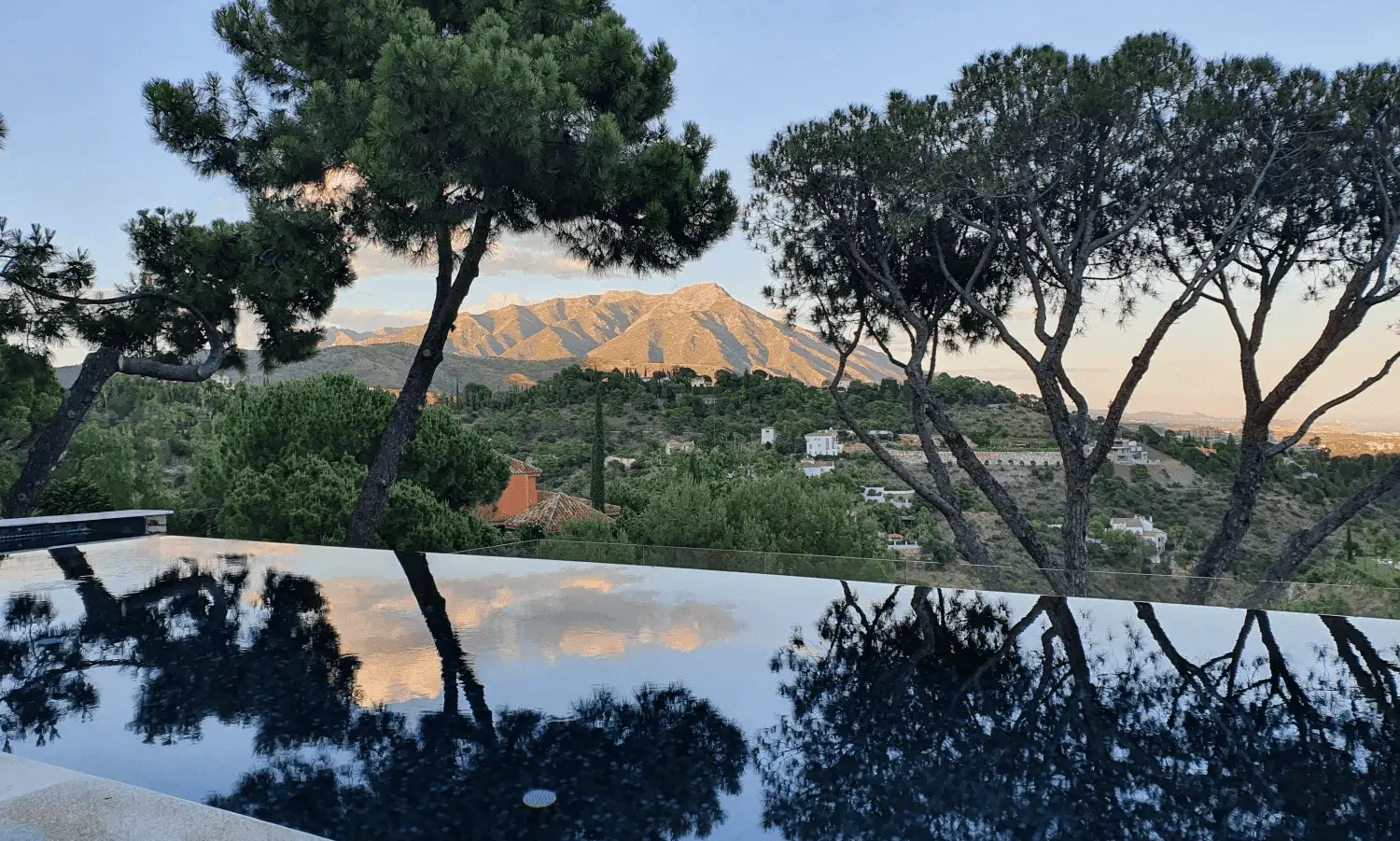
Many of the hillside communities of Benahavís offer almost the opposite arrangement. The beach, shops and restaurants may not be realistically walkable, and for most residents a car simply becomes part of everyday life. What you often gain in return is distance from the busiest coastal strip — less passing traffic, less parking pressure and, in many communities, a noticeably quieter environment once you return home.
Crucially, that does not necessarily mean being far from everything. La Quinta, Los Arqueros and other well-connected communities above San Pedro can still put Puerto Banús, beaches, supermarkets, restaurants and shopping within a relatively short drive. In real-world conditions, the time taken to reach a popular destination can sometimes be little different from travelling there from a geographically closer beachside or coastal urbanisation.
That distinction becomes much more noticeable in peak season. You can spend the afternoon on the beach, have dinner in Puerto Banús or meet friends in Marbella and then, within a comparatively short drive, leave much of the traffic, noise and activity behind.
It is one of the less obvious attractions of living slightly inland: you do not necessarily give up access to the action. You simply get to choose when to join it — and when to leave it behind.
9. Learn a little Spanish — but don't worry about performing Spanishness
A few words go a long way. Buenos días when you enter somewhere. Buenas tardes later in the day. Por favor, gracias, perdón and the occasional no pasa nada quickly become part of everyday life.
Nobody expects a newcomer to become fluent overnight, and this part of the Costa del Sol is unusually international. Benahavís itself has a substantial international community, something that has become part of the modern character of the municipality.
That internationalism is not separate from modern Costa del Sol life. It is part of it.
The aim therefore isn't to imitate some idealised version of a local. It is simply to engage with where you are. Make the effort to say hello. Learn the name of the person who serves your coffee. Try the Spanish rather than automatically beginning every conversation in English. Little interactions accumulate surprisingly quickly into a sense of belonging.
10. Eventually, the best bits stop being the famous ones
On a first visit, the landmarks naturally dominate. Marbella Old Town. Puerto Banús. The beach. A celebrated restaurant. Perhaps Ronda or a day trip along the coast.
Spend longer here and your relationship with the Costa del Sol becomes smaller and more personal.
It becomes the café where they already know what you drink. The stretch of beach you prefer in winter. Knowing which road to avoid at a certain time. An evening walk through Benahavís village after the day visitors have gone. The smell of jasmine on a warm night. A favourite table rather than the most famous restaurant.
Perhaps it is a walk beside the Guadalmina, an early round of golf, a Saturday morning market or simply knowing that the mountains will turn a particular colour just before the sun disappears.
That is probably the biggest unwritten rule of all: the Costa del Sol becomes considerably more interesting when it stops feeling like a destination and starts feeling like somewhere you know.
There is no single way to 'life on the Costa del Sol'
Perhaps that is why trying to write down the “rules” of the Costa del Sol is slightly contradictory in the first place.
This is a corner of Andalucía where lifelong local families, people from elsewhere in Spain, international residents, second-home owners and visitors have lived alongside one another for decades. Benahavís can be intensely Andalusian and remarkably international at exactly the same time.
You can have dinner at 7:30 if you want to. You don't have to develop an enthusiasm for golf. Nobody requires you to drink coffee a particular way, spend three hours over lunch or become fluent in Spanish before you are allowed to feel at home.
But understanding the rhythm around you changes the experience. You begin to know why the streets become busy when they do, why August feels so different from November and why two homes with the same Benahavís postcode can offer completely different lifestyles. Slowly, a place that initially seemed wonderfully foreign becomes wonderfully familiar.
Opening hours, journey times and traffic conditions vary by season, time of day and individual business. For current visitor information and local guidance, see the official Turismo Benahavís website and Andalucía's official tourism website.
Related Reading
Explore more of Benahavís, whether you are visiting for the first time or considering making the area home.
Explore
First-Time Visitor Guide to Benahavís
Where to start, what to see and how to experience Benahavís if you are discovering the area for the first time.
Living
Living in Benahavís
A closer look at everyday life in the municipality, from its landscape and communities to the practicalities of making a home here.
Food & Drink
Dining and Restaurants in Benahavís
Discover the village's celebrated restaurant scene and the wider range of places to eat across Benahavís.