Sustainable Property Benahavís: Eco-Friendly Luxury Homes Guide
How sustainability, energy performance, landscape protection and long-term planning are shaping luxury property in Benahavís.
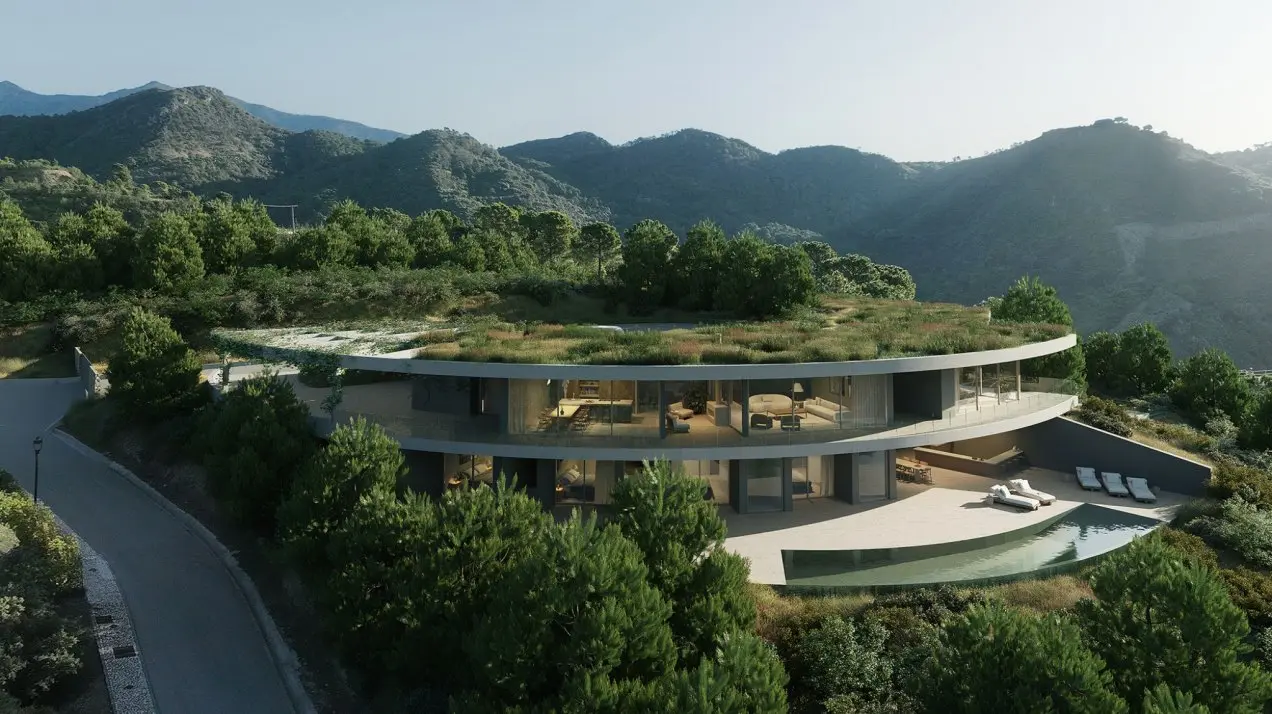
Sustainable property Benahavís is no longer a niche topic. Luxury buyers still care about architecture, views, privacy and location, but many now ask a more practical question: how efficient, resilient and future-proof will this home be over the next ten or twenty years?
In Benahavís, sustainability now influences master planning, construction standards, energy performance, water use, landscape protection and long-term property value. From BREEAM-led infrastructure planning to private eco-conscious villas with solar systems and smart climate control, environmental performance has become part of the luxury property conversation.
This is not simply about adding solar panels. It is about how homes, communities and protected landscapes work together. The most resilient properties are likely to be those that balance architecture, comfort, energy performance, running costs and respect for the natural setting that makes Benahavís so desirable.
Sustainable Property Benahavís: What Actually Matters?
In Spain, homes sold or rented generally need an Energy Performance Certificate, often referred to as an EPC. This gives buyers a useful starting point, because it indicates how efficient the home is in terms of energy consumption and emissions. However, EPC ratings are only one part of the story.
True sustainability in residential property goes further. It includes orientation, insulation, glazing, renewable energy, heating and cooling systems, smart-home energy management, water-conscious landscaping and the way a home sits within its wider environment.
For a Benahavís buyer, this wider view matters. A villa may have solar panels, but if the orientation is poor, the glazing is weak or the landscaping requires heavy irrigation, the overall sustainability story is less convincing. Equally, a well-planned community may offer a stronger long-term environmental position than an individual home with a few isolated eco features.
The best properties usually combine passive design with modern systems. They make intelligent use of light, shade and ventilation before relying on technology. Then, where technology is used, it supports comfort, efficiency and lower running costs rather than acting as a marketing label.
BREEAM, Real de La Quinta and Sustainable Planning
One of the most recognised sustainability benchmarks in Europe is BREEAM, the Building Research Establishment Environmental Assessment Methodology. For buyers evaluating sustainable property in Benahavís, this type of certification can provide a clearer long-term benchmark than isolated eco features.
Real de La Quinta is particularly relevant because it has been associated with BREEAM infrastructure and urban planning certification. This matters because infrastructure-level sustainability looks beyond an individual home. It considers wider planning principles such as land use, water strategy, biodiversity, transport, ecology, resources and long-term operational efficiency.
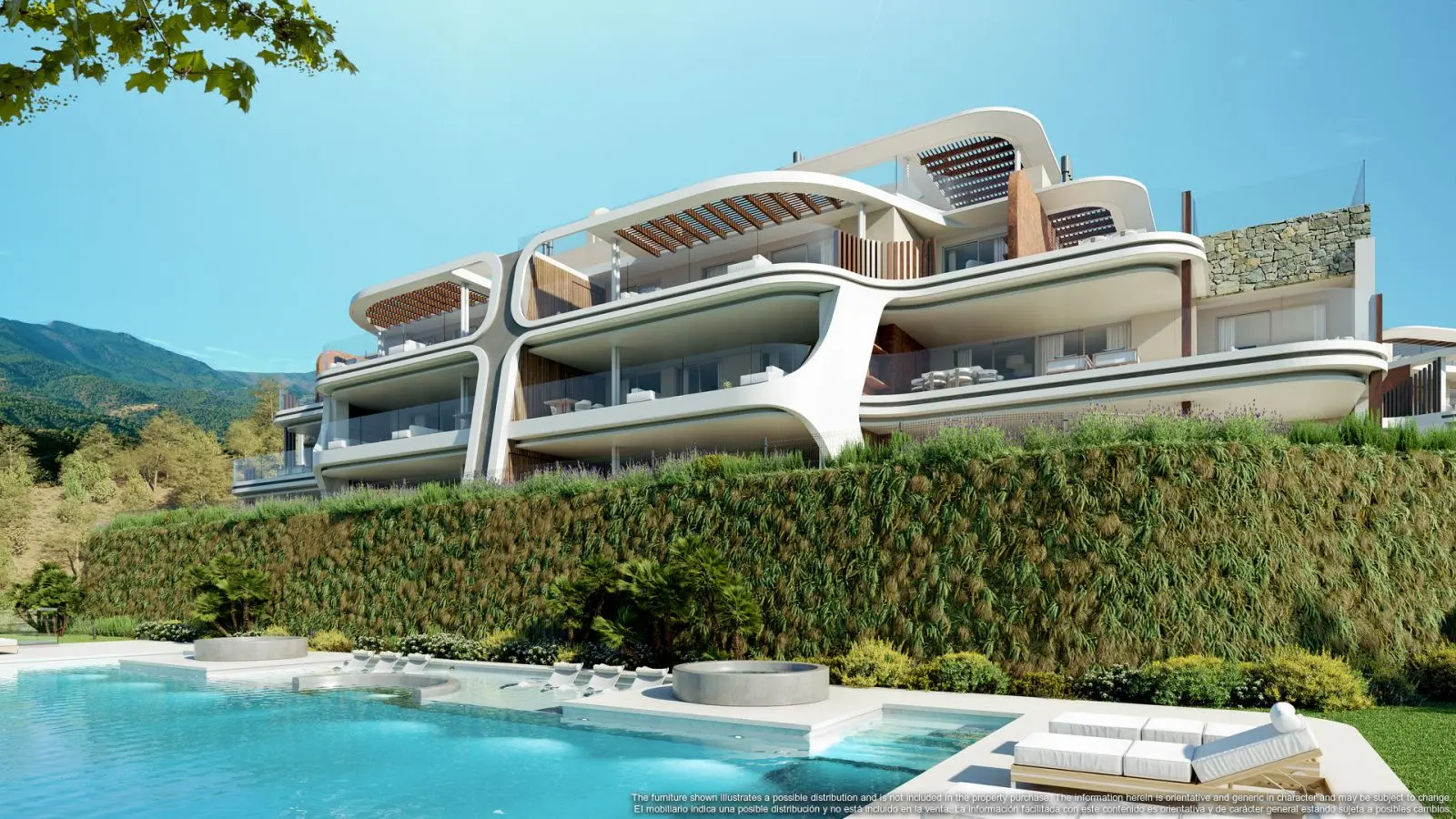
For buyers, infrastructure-level sustainability can influence future density, traffic flow, view protection, environmental management and the overall desirability of a community. In simple terms, sustainability at this scale is about structural resilience rather than cosmetic features.
Real de La Quinta’s own BREEAM information describes the development as the first project in Spain certified with the BREEAM seal for town-planning infrastructure. That does not mean every individual property should be judged in the same way, but it does give buyers a useful framework for understanding why community-level planning matters.
Read Real de La Quinta’s BREEAM information →
Landscape Protection and Long-Term Scarcity
Benahavís sits close to some of the most important protected natural landscapes in Málaga province. The Sierra de las Nieves National Park lies inland from the Costa del Sol, and the wider mountain environment plays a major role in the municipality’s appeal.
For property owners, this has two important implications. First, the landscape itself is part of the lifestyle. Mountain views, green valleys, cork oak hillsides and natural surroundings are central to why many buyers choose Benahavís over more densely built coastal areas.
Second, protected land and careful planning create scarcity. When surrounding landscapes cannot be freely or densely developed, view corridors and natural settings become more defensible over time. This can support long-term desirability for well-positioned homes, especially where architecture respects the terrain rather than dominating it.
In this context, sustainability is not only about technical specification. It is also about restraint, density, landscape integration and protecting the qualities that give Benahavís its character.
Read official Sierra de las Nieves National Park information →
Eco-Friendly Villas in Benahavís: What Buyers Are Prioritising
At villa level, sustainability often shows up in very practical ways. Buyers increasingly look for aerothermal systems, photovoltaic solar panels, battery storage, efficient underfloor heating, smart energy management, strong insulation, water-saving irrigation and native or drought-tolerant landscaping.
However, the most future-proof homes combine technology with intelligent design. Orientation remains one of the most important sustainability tools. A well-positioned home can reduce cooling demand in summer, improve winter comfort and make terraces, gardens and living spaces more usable throughout the year.
Shaded terraces, cross-ventilation, high-performance glazing and thoughtful planting can all make a noticeable difference. These details are sometimes less visible than a solar array or a smart-home panel, but they often determine how comfortable a property feels in everyday life.
International buyers are also looking more closely at documentation. EPC ratings, build specifications, system warranties, solar installation details, water systems and maintenance records all help buyers understand whether a home’s sustainability claims are meaningful or mainly decorative.
Does Sustainable Design Increase Build Costs?
Eco-conscious design can increase initial build budgets, but the impact depends heavily on specification. Enhanced insulation, high-quality glazing, solar panels, smart climate systems and battery storage all have costs. However, they can also improve comfort, reduce operating expenses and strengthen long-term desirability.
For buyers considering a new build or major refurbishment, sustainability is best considered from the start. Retrofitting can work, but it is usually more efficient to design orientation, shading, insulation, services and renewable systems into the project from day one.
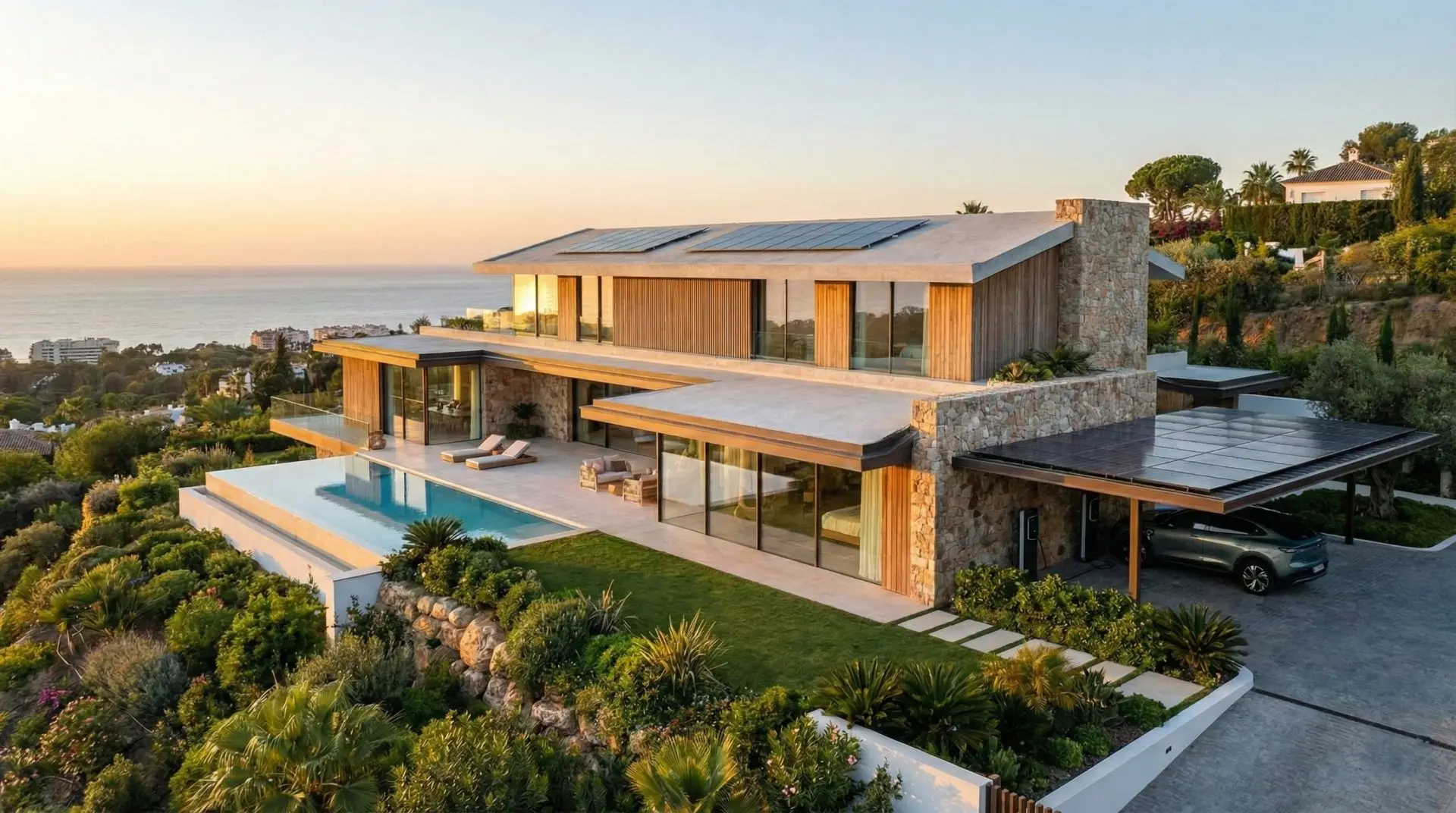
A villa designed around natural light, thermal comfort and efficient systems can feel better to live in as well as being less expensive to operate. In a high-end market, this can support both lifestyle appeal and future resale strength.
If you are planning a build, our guide to the cost to build a villa on the Costa del Sol is a useful next step.
Why Sustainable Property in Benahavís Supports Long-Term Value
Across Europe, energy efficiency and environmental performance are becoming more important in real estate. Buyers increasingly look at EPC ratings, energy consumption, water use, construction quality and long-term maintenance.
In Benahavís, this matters because the market is international. Many buyers come from countries where sustainability standards are already central to property decisions. Therefore, homes with better energy performance, renewable systems and strong environmental context may appeal to a wider buyer pool in the future.
The strongest properties are likely to balance architecture, natural light, privacy, landscape integration, efficient energy systems, strong documentation and long-term upgrade potential. Sustainable property in Benahavís is therefore not only about ethics or aesthetics. It can also support ownership comfort, regulatory alignment and future resale appeal.
For second-home owners, the benefits can be especially practical. A more efficient home is often easier to manage remotely, more comfortable on arrival and less exposed to rising energy costs. For full-time residents, the difference can be felt daily in comfort, air quality, temperature control and overall running costs.
Where Sustainability Meets Lifestyle
Sustainability in Benahavís does not mean compromise. Many eco-conscious homes are also architecturally striking, design-led and technologically advanced. The appeal lies in combining beauty with intelligence: homes that are elegant, comfortable and better aligned with the climate and landscape.
Real de La Quinta shows how sustainable planning can sit alongside resort-style amenities, panoramic views and contemporary architecture. Meanwhile, Monte Mayor reflects a different version of sustainability: low density, natural surroundings and architecture shaped by the landscape.
Buyers should also compare eco-friendly homes in Benahavís with modern homes in Benahavís, because contemporary architecture and sustainable specification often overlap.
The best choice depends on the buyer. Some will prioritise renewable systems and EPC performance. Others will care more about landscape protection, privacy and low-density surroundings. The strongest homes often offer both.
FAQs About Sustainable Property in Benahavís
What makes a property sustainable in Benahavís?
A sustainable property usually combines energy efficiency, strong insulation, efficient climate systems, renewable energy, water-conscious landscaping and design that works with the local climate.
Is an EPC enough to judge sustainability?
No. The EPC is important, but it is only one part of the picture. Orientation, glazing, insulation, water systems, materials, renewable energy and community planning also matter.
Are eco-friendly homes more expensive to buy?
They can be, especially if they include high-quality systems or newer construction. However, better efficiency may reduce running costs and improve long-term resale appeal.
Can older villas be upgraded?
Yes. Many older villas can be improved with solar panels, battery storage, better glazing, insulation, heat pumps, smart controls and more efficient irrigation.
Which areas are most relevant for sustainable property in Benahavís?
Real de La Quinta, La Reserva del Alcuzcuz, Monte Mayor, La Quinta and selected modern villa areas are especially relevant, although eco-conscious homes can appear across the municipality.
Conclusion: A Structural Shift, Not a Trend
Sustainability in Benahavís is not a short-term marketing trend. It is a structural shift driven by planning regulation, environmental protection, international buyer expectations and long-term asset preservation.
For buyers evaluating luxury property on the Costa del Sol, understanding how sustainability influences infrastructure, density, energy performance and design is increasingly important. The most resilient properties of the next decade are likely to be those that balance architecture, landscape and environmental logic, not simply those that maximise build volume.
Looking for Eco-Conscious Homes in Benahavís?
Browse our curated collection of sustainable and energy-efficient homes, or ask us to prepare a tailored shortlist based on your preferred areas, budget and sustainability priorities.
Related Reading
Eco-Friendly Homes in Benahavís
Browse homes selected for sustainable design, energy efficiency, renewable systems or lower long-term running costs.
Real de La Quinta Area Guide
Explore one of Benahavís’ most relevant master-planned communities for sustainable design and modern living.
Cost to Build a Villa on the Costa del Sol
Understand build costs, licences and planning considerations when designing a modern or eco-conscious villa.
Looking for a home outside Benahavís?
Holiday Homes Spain
covers the whole Costa del Sol.