Understanding the 2026 Andalusian Elections: A Guide for International Residents in Benahavís
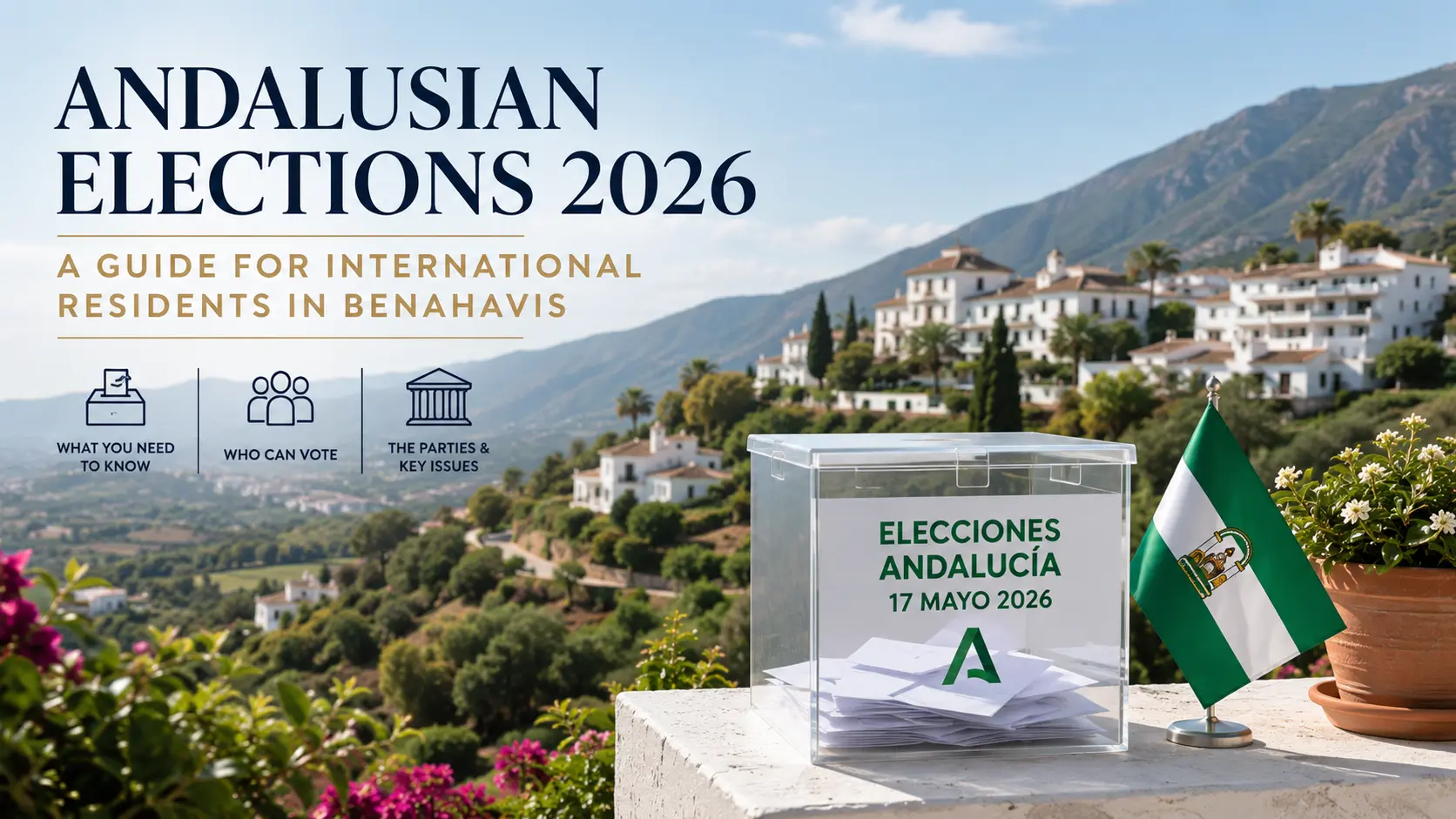
On Sunday 17 May 2026, Andalucía will hold regional elections to choose the next Parliament of Andalucía and determine the government of the Junta de Andalucía.
For many international residents in Benahavís, the Spanish political system can feel unfamiliar. Spain has separate local, regional, national and European elections, each with different rules about who can vote and what powers each government holds.
Most international residents living in Benahavís — including British residents after Brexit, other non-EU citizens and even EU nationals resident in Spain — are not entitled to vote in Andalusian regional elections. However, the result still matters because the regional government oversees many areas that affect daily life on the Costa del Sol, including healthcare, education, roads, water management, housing policy, environmental regulation and tourism infrastructure.
Therefore, this article is intended as an impartial interest piece for English-speaking residents who want to understand what is happening politically in Andalucía, which parties are involved and which issues are being discussed. Benahavís Collection is not affiliated with any political party or campaign and does not endorse any candidate or political organisation.
Election Update: The 2026 Andalusian regional election has now taken place. We have published a follow-up article covering the results and what they may mean for Benahavís, international residents and the Costa del Sol property market.
What Are the 2026 Andalusian Elections?
The elections on 17 May are for the Parliament of Andalucía, the regional legislature covering all eight Andalusian provinces, including Málaga.
Voters elect representatives to the regional parliament. Those representatives then determine who becomes President of the Junta de Andalucía — effectively the head of the Andalusian regional government.
The Andalusian government influences many areas of everyday life, including public healthcare, state schools, regional roads, environmental policy, water management, tourism planning, housing regulation, public transport and emergency services.
This election is separate from Benahavís Town Hall elections, Spain’s national elections in Madrid and European Parliament elections. For residents on the Costa del Sol, regional politics can still have a significant influence on long-term infrastructure, investment and public services.
Who Can Vote?
One of the most common questions among international residents is whether foreign residents can vote in these elections.
For the Andalusian regional elections, only Spanish citizens aged 18 or over who are correctly registered on the electoral roll may vote.
This means Spanish citizens resident in Spain may vote. Spanish citizens living abroad may also vote if they are registered correctly. However, EU citizens resident in Spain cannot vote in these elections unless they hold Spanish nationality. British residents and other non-EU residents cannot vote either.
This can cause confusion because foreign residents may vote in some other Spanish elections. For example, EU citizens resident in Spain may vote in municipal elections and European Parliament elections. British residents may also vote in local municipal elections because Spain and the UK maintain a reciprocal voting agreement following Brexit. However, those voting rights do not extend to Andalusian regional elections.
So, while many international residents in Benahavís will not be voting next month, the election remains relevant because the regional government influences many practical aspects of life in Andalucía.
Where Will People Vote in Benahavís?
At the time of writing, the official polling station list for Benahavís has not yet been widely published online.
Traditionally, voting takes place in public municipal buildings within Benahavís Village. Registered Spanish voters usually receive an official polling card by post confirming their assigned polling station, electoral district, table number and voting times.
Polling stations in Spain are typically open from 9:00am until 8:00pm on election day. Residents who are uncertain where they are registered should check with the local town hall or wait for their official electoral documentation to arrive.
The Main Political Parties in Andalucía
Several parties are contesting the 2026 Andalusian elections. Below is a neutral overview of the principal parties most likely to influence the next regional government.
The summaries are intended purely as informational descriptions rather than endorsements.
Partido Popular de Andalucía (PP)
Leader: Juanma Moreno
Political alignment: Centre-right
The Partido Popular currently governs Andalucía and won a parliamentary majority in the previous regional election. The party’s campaign focuses heavily on economic growth, attracting investment, tourism competitiveness and reducing administrative bureaucracy.
The PP also places emphasis on infrastructure investment, water projects linked to drought management and maintaining Andalucía’s appeal for both international business and tourism. The party argues that the region has become more economically dynamic and attractive to investors during its time in government.
For residents of Benahavís and the wider Costa del Sol, the PP has highlighted themes such as road improvements, economic confidence, international investment and supporting Andalucía’s position as one of Europe’s leading tourism destinations. Critics, however, have raised concerns about pressure on public healthcare and education services in rapidly growing areas of Málaga province.
PSOE-A
Leader: María Jesús Montero
Political alignment: Centre-left / social democratic
The PSOE governed Andalucía for many decades prior to 2019 and remains one of the region’s largest political forces. The party’s campaign centres on increased investment in public healthcare, education, affordable housing and public transport infrastructure.
The PSOE also advocates stronger environmental protections and expanded social spending. Party representatives have argued that rapid population growth in parts of Andalucía has placed increasing pressure on schools, hospitals and local infrastructure.
In municipalities such as Benahavís and nearby Marbella, PSOE representatives have recently discussed issues including school capacity, healthcare waiting times and the need for further educational investment as the area’s permanent population continues to grow.
Vox Andalucía
Leader: Manuel Gavira
Political alignment: Right-wing / national conservative
Vox has become increasingly influential in Andalusian politics over recent years. The party campaigns on themes including lower taxation, reducing bureaucracy, stronger public security policies and tighter immigration controls.
The party also advocates reforms to certain environmental and equality legislation and places strong emphasis on Spanish national identity and institutional centralisation.
For Costa del Sol residents, Vox frequently discusses infrastructure capacity, administrative efficiency, urban growth and public security. The party also positions itself as supportive of reducing regulation affecting businesses and property owners.
Por Andalucía
Leader: Antonio Maíllo
Political alignment: Left-wing alliance
Por Andalucía is a coalition of several left-wing political groups. The alliance campaigns on expanding public services, environmental protection, labour rights and housing affordability.
The coalition also advocates stronger public investment in healthcare and education and supports policies aimed at limiting housing pressure in high-demand urban areas.
In the Costa del Sol region, Por Andalucía has focused on balancing tourism growth with environmental sustainability, improving public transport infrastructure and addressing affordability concerns linked to rising property prices in parts of Andalucía.
Adelante Andalucía
Leader: José Ignacio García
Political alignment: Left-wing Andalusian regionalist
Adelante Andalucía promotes stronger Andalusian regional identity and greater autonomy for the region within Spain. The party also campaigns on environmental sustainability, anti-corruption measures and increased public investment.
Its platform places emphasis on protecting local communities and ensuring economic development remains balanced and sustainable.
For residents in areas such as Benahavís and Marbella, the party has discussed issues including water management, environmental conservation, infrastructure planning and concerns around overdevelopment along parts of the Andalusian coastline.
Why These Elections Matter on the Costa del Sol
Even for residents who cannot vote, the 2026 Andalusian elections may still influence the future direction of the Costa del Sol in important ways.
The next regional government will help shape decisions relating to healthcare funding, hospital capacity, state school investment, water and drought infrastructure, regional roads, transport, tourism strategy, housing policy, environmental protection and long-term planning.
For an international municipality such as Benahavís — where residents come from many different countries and backgrounds — these decisions can affect everything from quality of life and commuting infrastructure to education availability and long-term property market confidence.
A Different Political Culture
International residents often notice that Spanish election campaigns can feel different from those in northern Europe, the UK or North America.
Campaigning in Andalucía is typically highly visible in the weeks leading up to election day, with street posters, public rallies, local events and extensive television coverage. Political discussion also tends to be more openly integrated into daily social life, particularly in cafés, restaurants and community gatherings.
At the same time, Andalucía remains politically diverse, with support spread across centre-right, centre-left, conservative, socialist and regionalist movements depending on municipality, age group and economic priorities.
In areas such as Benahavís and Marbella, conversations often focus less on ideology and more on practical issues including infrastructure, healthcare access, traffic, schools, water supply and the long-term management of growth along the Costa del Sol.
Important Dates
Election day takes place on Sunday 17 May 2026, with polling stations generally open from 9:00am until 8:00pm.
The official campaign period is already underway across Andalucía, and residents can expect increasing political visibility throughout the coming weeks both locally and across Spanish media.
Final Thoughts
For many international residents in Benahavís, the 2026 Andalusian elections are less about voting directly and more about understanding the political and social direction of the region they now call home.
Whether discussing schools, healthcare, transport, water management or the future growth of the Costa del Sol, the decisions made at regional level often have a meaningful impact on daily life across southern Spain.
While most foreign residents will not participate directly in the vote, understanding how the system works — and the priorities of the different parties — can still provide useful context for life in Andalucía.
Discover More About Living in Benahavís
Thinking about making Benahavís your permanent home, spending more time on the Costa del Sol, or exploring your next move within the municipality?
Explore our curated collection of homes, apartments and villas across Benahavís, discover the different areas and lifestyles that shape the municipality, or learn how we help local owners present their property to a serious international audience.
→ Search Property in Benahavís
→ Selling a Property in Benahavís?
2026 Andalusian Elections: Benahavís Resident Guide