What the 2026 Andalusian Election Results Mean for Benahavís and the Costa del Sol
A practical guide for international residents, homeowners and buyers watching how Andalucía’s political direction may shape healthcare, infrastructure, tourism, housing and long-term investment across the Costa del Sol.
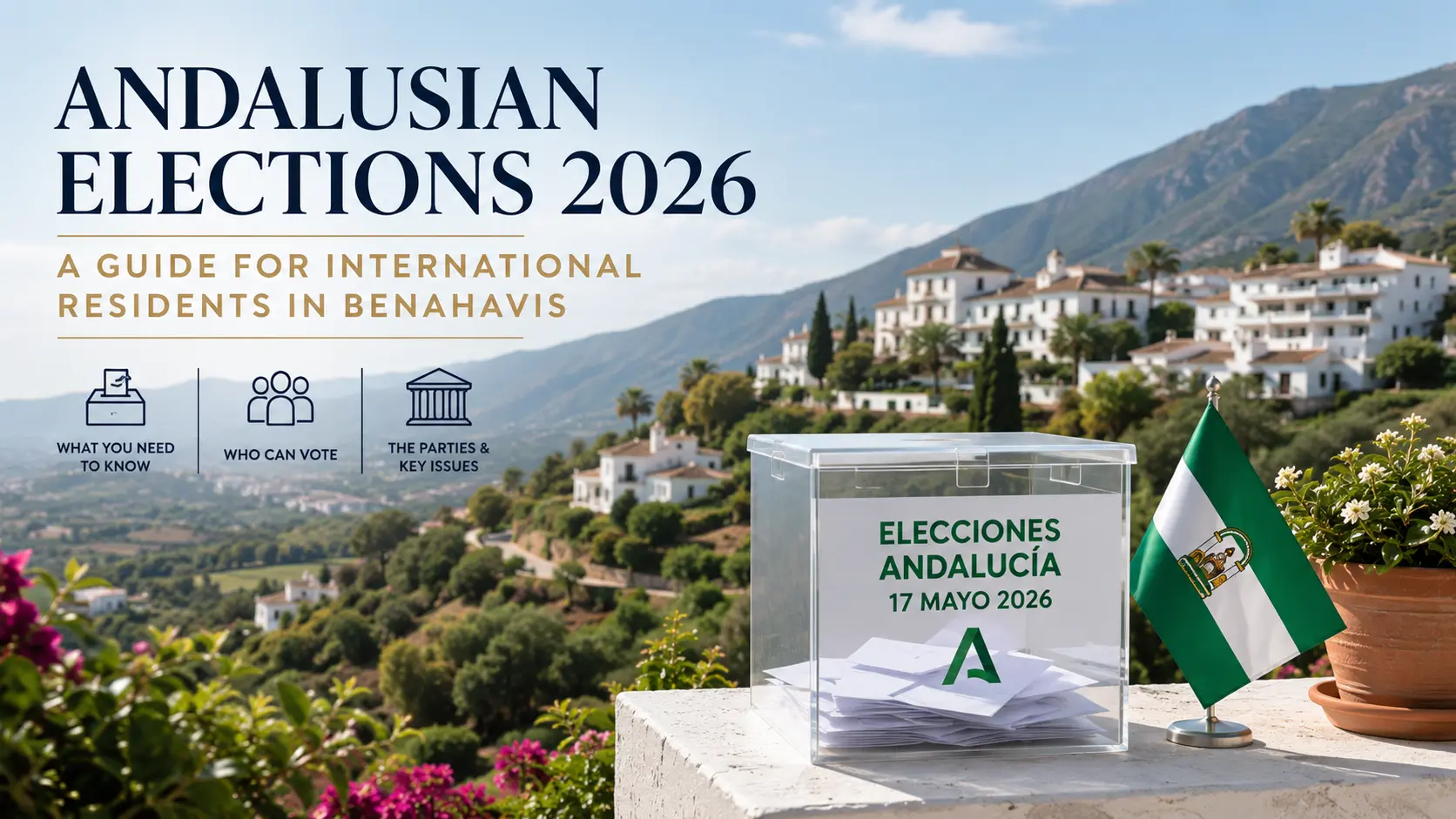
The results of the 2026 Andalusian regional elections are now confirmed — and while the outcome may not dramatically change daily life overnight in Benahavís, the result is likely to influence the direction of Andalucía, the Costa del Sol property market and regional infrastructure over the coming years.
For many international residents across Benahavís, Marbella and the wider Costa del Sol, these elections are often observed from a distance rather than participated in directly. Most foreign residents cannot vote in Andalusian regional elections. However, the policies of the Junta de Andalucía still affect healthcare, schools, transport infrastructure, water management, tourism policy, housing and long-term investment across southern Spain.
As a result, many international residents have followed this election with interest — particularly given the growing debate around healthcare, overtourism, infrastructure pressure and housing affordability across parts of Andalucía.
The Result: PP Wins Again, But Loses Its Absolute Majority
The centre-right Partido Popular de Andalucía (PP), led by Juanma Moreno, once again finished as the largest political force in Andalucía. However, unlike the previous election in 2022, the party lost its outright parliamentary majority.
The PP secured 53 seats in the Andalusian parliament — remaining comfortably ahead of its rivals but falling just short of the 55 seats needed for an absolute majority.
The result means the PP is now expected to rely on support or abstention from Vox in order to continue governing Andalucía. Vox slightly increased its representation to 15 seats, while the PSOE recorded its weakest Andalusian result in decades.
Meanwhile, Adelante Andalucía significantly improved its performance, reflecting growing support for regionalist and alternative left-wing politics in parts of the region.
Why the Result Matters on the Costa del Sol
Although Benahavís is internationally known for luxury property, golf communities and tourism, many of the issues debated during the election campaign were highly relevant to residents on the Costa del Sol.
Healthcare capacity was one of the dominant topics during the campaign, particularly following criticism of waiting times and pressure on Andalucía’s public health system. Education and school infrastructure also featured heavily in discussions, especially in rapidly growing municipalities around Málaga province.
Other major campaign issues included water infrastructure, drought management, transport investment, housing affordability and the long-term impact of population growth across coastal Andalucía.
For municipalities such as Benahavís, Marbella and Estepona — all of which continue to attract international buyers and full-time residents — these themes are increasingly important as the Costa del Sol evolves from a seasonal tourism destination into a year-round residential region.
What This Could Mean for International Residents
For most international residents, the election result is unlikely to create immediate changes to residency rules, property ownership or taxation. Spain’s immigration framework and most major tax legislation are determined nationally in Madrid rather than regionally in Andalucía.
However, the regional government still controls many practical aspects of life that affect foreign residents directly.
The continuation of a broadly business-friendly and investment-focused regional administration is likely to reassure many property owners and investors on the Costa del Sol. The PP government has generally promoted tourism, foreign investment and infrastructure development throughout its time in office.
At the same time, the stronger position of Vox within the regional parliament may lead to louder political debate around immigration, housing pressures and public spending priorities — even if major policy changes remain uncertain.
For many residents, the practical questions remain familiar ones: healthcare access, road congestion, school availability, water security and how the Costa del Sol manages continued growth while preserving quality of life.
The Property Market Perspective
From a property market perspective, the election result is generally being viewed as a continuation of political stability rather than a dramatic shift in direction.
International demand for homes in Benahavís, Marbella and surrounding areas remains strong, particularly from buyers relocating permanently or spending increasing amounts of time in southern Spain.
The Costa del Sol continues to benefit from:
- international lifestyle demand,
- remote working trends,
- year-round tourism,
- high-end infrastructure investment,
- and continued interest from northern European buyers.
However, infrastructure pressures are becoming increasingly visible. Traffic congestion, healthcare demand, school capacity and water availability are now central political issues rather than secondary concerns.
The next Andalusian government will therefore face growing pressure to balance continued economic growth with sustainable infrastructure planning — particularly along the Málaga coastline.
A More Politically Diverse Andalucía
One of the clearest themes of this election was the continued fragmentation of Andalusian politics.
While the PP remains the dominant force, the loss of its absolute majority reflects a more politically divided electorate than in 2022. The PSOE continues to struggle in Andalucía, Vox remains influential and smaller regionalist and left-wing parties gained visibility during the campaign.
For international residents, this is perhaps most visible in the growing public debate around how Andalucía should manage growth, infrastructure and tourism over the next decade.
Those conversations are increasingly shaping policy discussions across the Costa del Sol — including in municipalities such as Benahavís.
Final Thoughts
For many people living in Benahavís, the Andalusian elections were less about party politics and more about understanding the future direction of the region they now call home.
The result suggests continuity rather than radical change. Andalucía remains politically stable, economically attractive and internationally focused. However, the election also highlighted growing debate around healthcare, infrastructure, housing and the long-term sustainability of growth across the Costa del Sol.
For international residents and property owners, those issues are likely to become increasingly important over the coming years — regardless of political affiliation.
Discover More About Living in Benahavís
Thinking about making Benahavís your permanent home, spending more time on the Costa del Sol, or exploring property opportunities within the municipality?
Explore our curated collection of homes, apartments and villas across Benahavís, discover the different areas and lifestyles that shape the municipality, or learn how we help local owners present their property to a serious international audience.
Search Property in Benahavís
Explore villas, apartments, townhouses, new developments and lifestyle-led homes across Benahavís and nearby prime areas.
Discover Areas of Benahavís
Compare the village, hillside estates, golf communities and residential areas that shape the municipality’s lifestyle and appeal.
Selling a Property in Benahavís?
Learn how we position Benahavís homes for serious international buyers through careful presentation and global exposure.
FAQs: 2026 Andalusian Election Results and Benahavís
Do the 2026 Andalusian election results directly affect foreign residents in Benahavís?
The 2026 Andalusian election results do not directly change the legal position of most foreign residents in Benahavís. Residency rules, visas and nationality matters are mainly decided by Spain’s national government rather than the Junta de Andalucía. However, the regional government does influence many everyday services, including healthcare, education, regional infrastructure, tourism policy and water management. For that reason, the results still matter to international residents who live in Benahavís full-time or spend long periods on the Costa del Sol.
Can international residents vote in Andalusian regional elections?
In general, non-Spanish residents cannot vote in Andalusian regional elections. This includes EU citizens, British residents after Brexit and other non-EU nationals, unless they also hold Spanish nationality. This often causes confusion because some foreign residents can vote in local municipal elections, and EU citizens can also vote in European Parliament elections. The 2026 Andalusian election results were therefore decided by Spanish citizens, but the outcome may still affect the wider international community living in Andalucía.
What could the 2026 Andalusian election results mean for the Costa del Sol property market?
For the Costa del Sol property market, the 2026 Andalusian election results are likely to be viewed mainly through the lens of stability, investment confidence and infrastructure planning. Buyers in areas such as Benahavís, Marbella and Estepona tend to watch issues such as transport, healthcare capacity, water security, tourism management and planning regulation. While regional election results rarely transform the property market overnight, they can influence the long-term environment in which international buyers, sellers and investors make decisions.
Will property taxes or buying costs change because of the 2026 Andalusian election results?
There is no automatic change to property taxes or purchase costs simply because of the 2026 Andalusian election results. Some taxes are regional, while others are national or municipal, so any future changes would need to be introduced through the appropriate legal process. Buyers and sellers should continue to take professional tax and legal advice before making decisions. For most international property owners, the more immediate questions are likely to relate to infrastructure, services and confidence in Andalucía’s long-term direction.
Why are the 2026 Andalusian election results important for Benahavís?
The 2026 Andalusian election results are important for Benahavís because many regional decisions affect daily life in the municipality, even when they are not made by the town hall. Healthcare funding, education investment, regional roads, environmental policy, tourism strategy and water infrastructure are all influenced at Andalusian level. As Benahavís continues to attract international residents and second-home owners, these wider regional policies help shape the quality of life and long-term appeal of the area.
Where can residents follow official updates after the election?
Residents who want official information following the 2026 Andalusian election results should consult recognised public sources such as the Junta de Andalucía, Spain’s official electoral information channels and Benahavís Town Hall for local notices. English-language summaries can be helpful for context, but official Spanish sources should always be checked for legal, electoral or administrative details.
Looking for a home outside Benahavís?
Holiday Homes Spain
covers the whole Costa del Sol.